10 años 2020 – 4

Cuarta y última entrada del año 2020

Venimos de aquí:  https://moneditis.com/2025/05/03/10-anos-2020-3/

https://moneditis.com/2025/04/12/10-anos-2020-2/

https://moneditis.com/2025/03/21/10-anos-2020-1/

https://moneditis.com/2025/02/21/10-anos-2019-4/

https://moneditis.com/2025/01/25/10-anos-2019-3/

https://moneditis.com/2024/12/05/10-anos-2019-2/

https://moneditis.com/2024/11/09/10-anos-2019-1/

https://moneditis.com/2024/10/19/10-anos-2018-5/

https://moneditis.com/2024/09/20/10-anos-2018-4/

https://moneditis.com/2024/08/06/10-anos-2018-3/

https://moneditis.com/2024/08/06/10-anos-2018-2/

https://moneditis.com/2024/07/12/10-anos-2018-1/

https://moneditis.com/2024/06/23/10-anos-2017-5/

https://moneditis.com/2024/06/01/10-anos-2017-4/

https://moneditis.com/2024/05/25/10-anos-2017-3/

https://moneditis.com/2024/04/27/10-anos-2017-2/

https://moneditis.com/2024/04/11/10-anos-2017-1/

https://moneditis.com/2024/03/22/10-anos-2016-4/

https://moneditis.com/2024/01/25/10-anos-2016-3/

https://moneditis.com/2024/01/25/10-anos-2016-2/

https://moneditis.com/2024/01/25/10-anos-2016-1/

https://moneditis.com/2023/12/16/10-anos-2015-5/

https://moneditis.com/2023/12/08/10-anos-2015-4/

https://moneditis.com/2023/11/25/10-anos-2015-3/

https://moneditis.com/2023/11/18/10-anos-2015-2/

https://moneditis.com/2023/11/04/10-anos-2015-1/

https://moneditis.com/2023/10/28/10-anos-2014-4/

https://moneditis.com/2023/10/14/10-anos-2014-3/

https://moneditis.com/2023/09/30/10-anos-2014-2/

https://moneditis.com/2023/09/16/10-anos-2014-1/

https://moneditis.com/2023/08/30/10-anos-2013/

Vamos a por la trigésima segunda (32) entrada conmemorativa; el enlace inferior conecta con la parte del blog tratada, a partir de octubre de 2020

https://moneditis.com/page/23/     

Junk Silver / Plata Basura  con 20 francos suizos falsos en el post scriptumEfimok II / ефимок II  con interesantes comentarios sobre falsificaciones en el post scriptum también, entre los que destaco:

«…A mi me han ofrecido comprar aureos a 1000 euros que tenian ese precio por ser unicos, es decir, se hace un aureo, se rompe el troquel y unicamente queda tu aureo, esto tambien se hace con denarios y con otro tipo de monedas, esos aureos luego con un certificado pueden llegar a valer cinco veces mas como poco, si es un aureo especial puede llegar a los 30.000 o 50.000 euros, un denario imagina que te lo venden a 300 o 400 pero ese denario vale 4000 o 5000 euros. Esto eran gente que llegaban con maletines llenos de este tipo de moneda, normalmente era un italiano el que aparecia con estos maletines, italiano diferente al de los tetradracmas.

En moneda medieval española hay varios especialistas y sus copias en caso de que quieran hacerlas unicas son imposibles de detectar, la unica manera de poder detectarlas es que se hagan varias monedas del mismo cuño y conforme van saliendo al mercado darte cuenta de que son clones acuñados, si fueran fundidos si pueden llegar a reconocerse por un ojo experto.

Casi todos los talleres estan por el sur de españa, casi todos estan operando de forma legal, pero hay otros que son como las reliquias, sabes que estan, sabes que esisten pero no hay manera de saber quien tiene ese taller, por ejemplo el famoso taller de las cabezas de san juan, nunca he llegado a saber nada de su dueño, debe de ser un tio muy listo con un bajo perfil y con clientes ya buscados, se sabe que esiste desde hace años pero nadie sabe nada de el.

Luego estan los bulgaros, especialistas en moneda romana y en arqueologia, casi todo lo que se vende hoy en dia es de de ellos, hacen entalles en piedras naturales que venden a 40 euros que luego pueden como poco triplicar su valor con un certificado…»

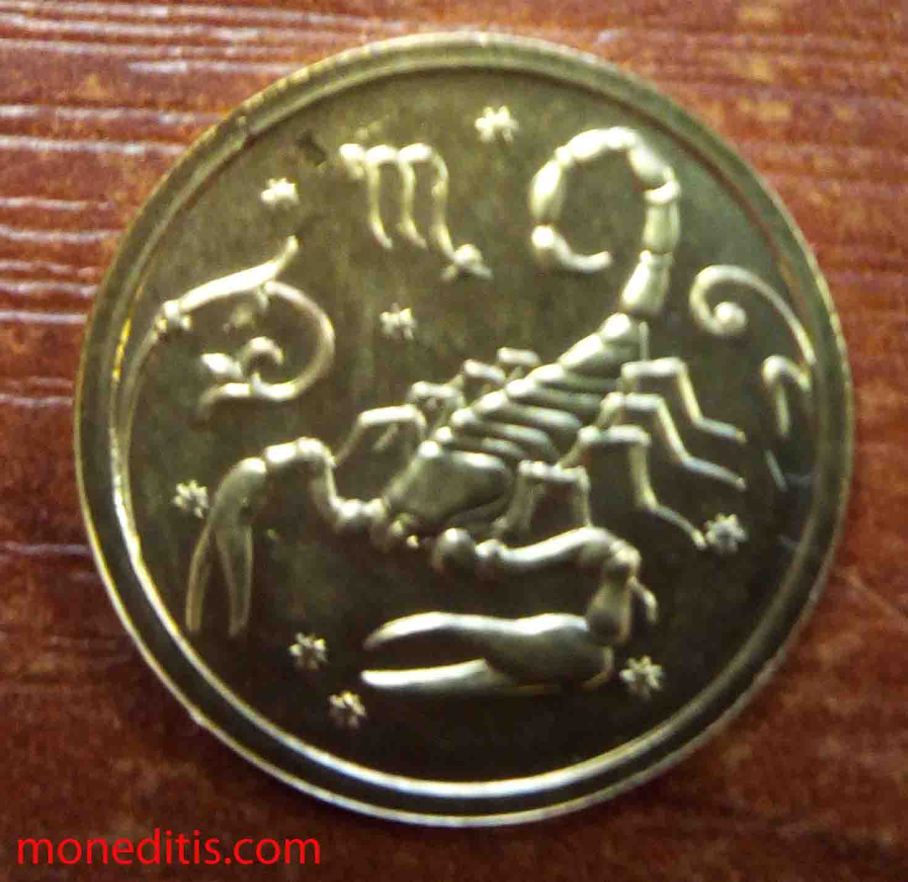
Sigo con signos del zodiaco: escorpión y anteriores

https://moneditis.com/2020/10/22/%d1%81%d0%ba%d0%be%d1%80%d0%bf%d0%b8%d0%be%d0%bd-escorpio/

Yo Julia Denarios  entrada sobre el libro de Santiago Posteguillo y sus monedas,   8 reales Carlos IV Ibercoin lotes ¿cruz? con diversos reales de a ocho de busto y falsificaciones,   Real de a Ocho Audio  en memorias de un tambor + 4 ducados falsos

Subastas Reales Rusas   

96 копеек «Ливонез»

Следующий номинал является очень непривычным для российской системы денежного обращения, поскольку ориентирован не на десятеричную, талерную. Внешнеполитические успехи елизаветинского времени оставили свой след в двух региональных выпусках монет. Первый — это монеты для прибалтийских провинций Ливонии и Эстляндии.

Необычный номинал свидетельствует о попытке привязать русскую денежную систему к талерной, основанной на 12-кратном счете и привычной для населения провинций. На оборотных сторонах монет 96, 48 и 24 копейки в клювах орла на лентах подвешены гербы городов Риги и Ревеля (с 1917 года — Таллин).

Чеканились в Москве на Красном дворе петербургскими штемпелями работы Б. Скотта.

Лицевая сторона — портрет императрицы, оборотная — российский двуглавый орел с гербами Риги и Ревеля и надпись MONETA LIVOESTHONICA, цифра 96 и дата. Проба — 750, нормативный вес — 26,38 грамма, гурт — узор.

Y terminando este 2020   Más Julia Denarios y Áureos y dioses  segunda parte de la entrada anterior,    Oro y Plata confiscados   con datos sobre órdenes ejecutivas yankees y lo que puede pasar ante la quiebra del estado  ,   fakes gold & silver coins   con bollicaos (lingotes rellenos) y monedas (maple leaf) y     Christmas Scrooge Crown Dickens    cuento de Navidad, con sus correspondientes Post Scriptum que os invito a examinar

Empezaremos el 2021 con subasta Goldberg en Nueva York

Lo dejamos aquí    https://moneditis.com/page/22/

CECAS Indianas

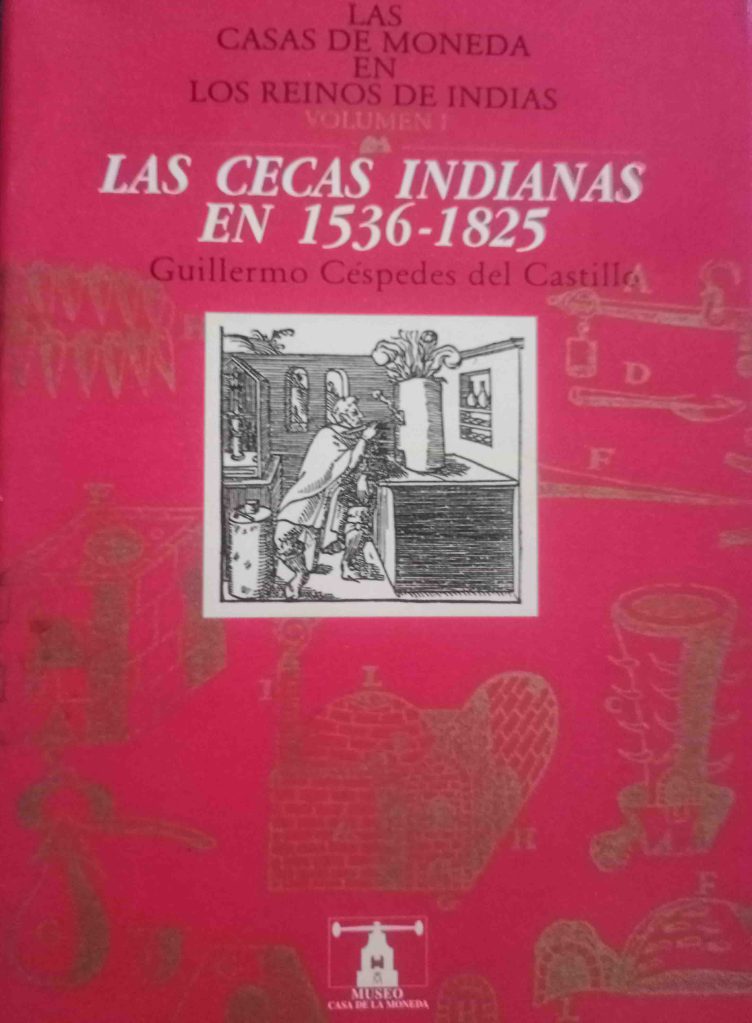
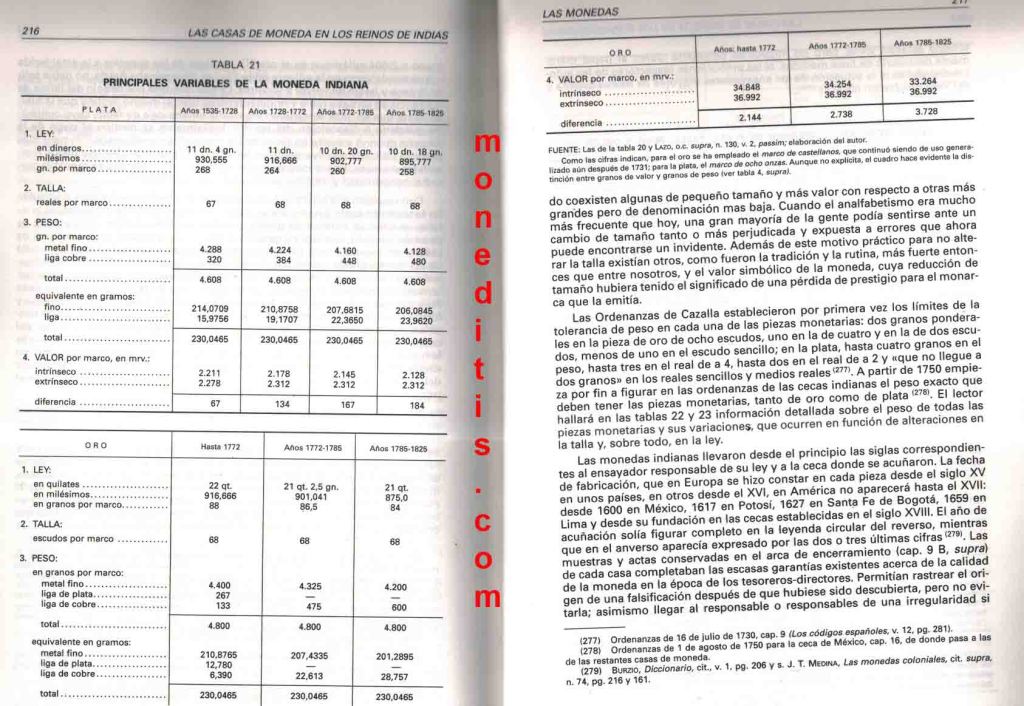
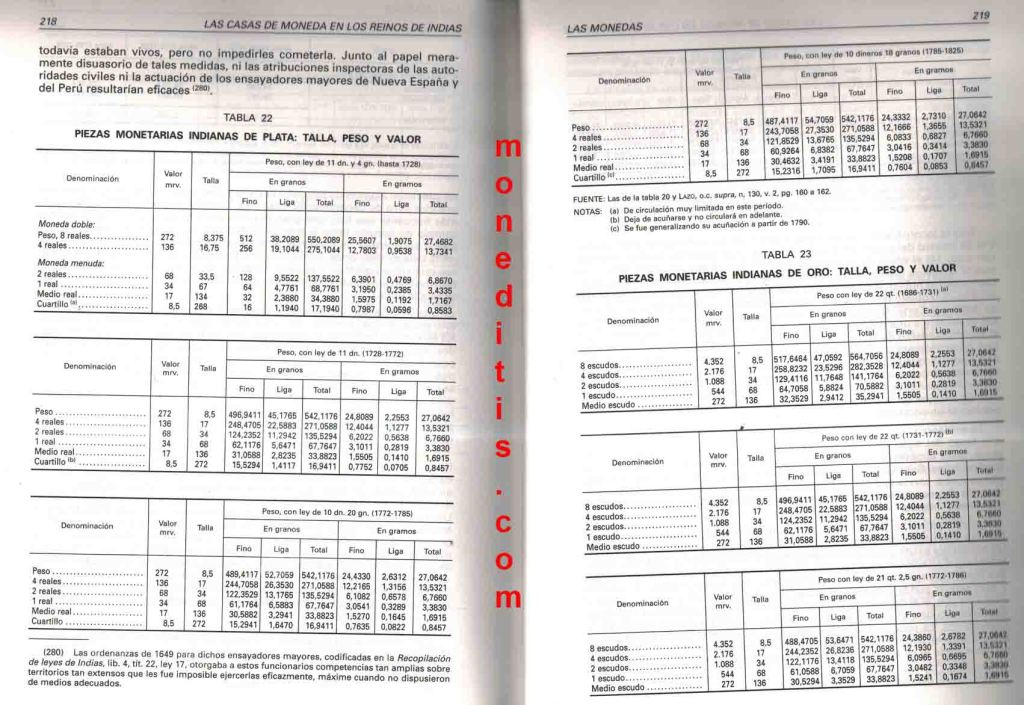
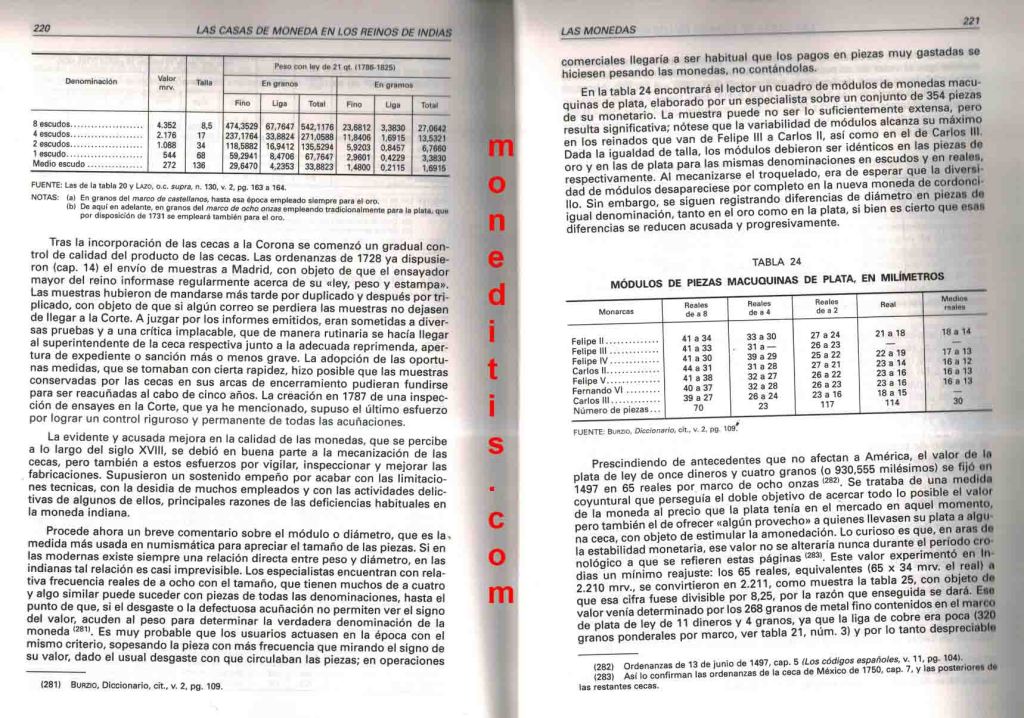
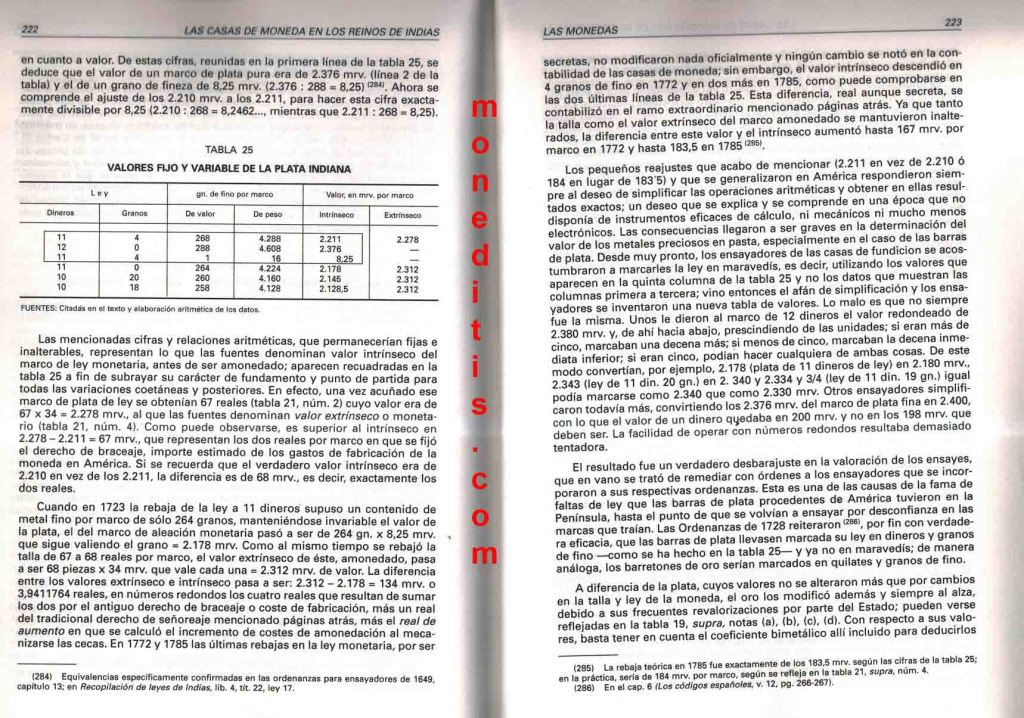
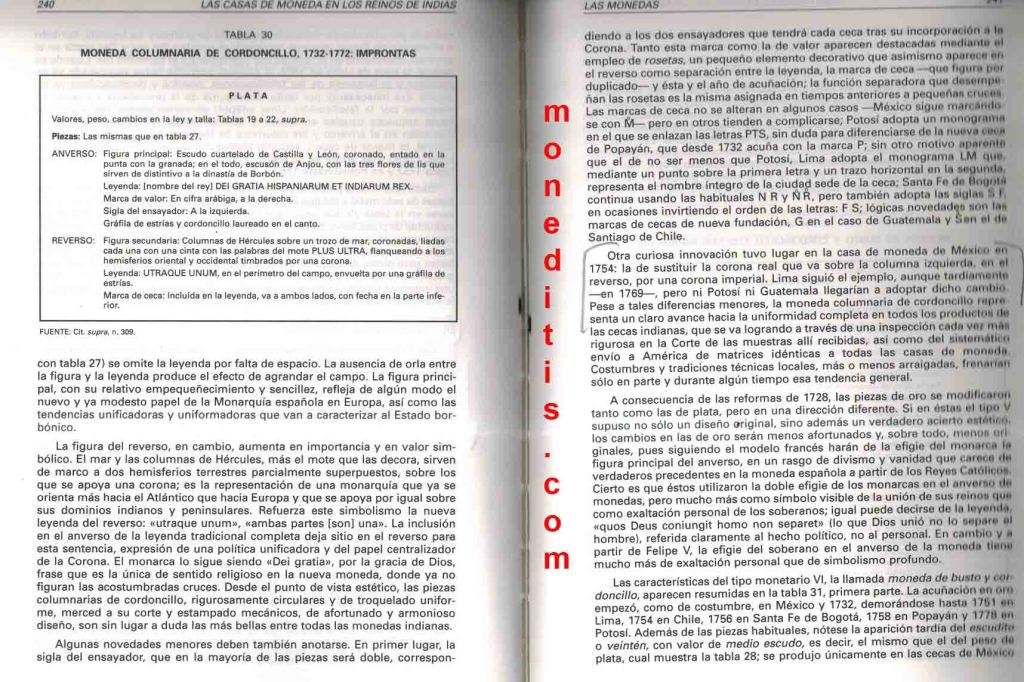
En el Post Scriptum de esta entrada sobre las onzas españolas  https://moneditis.com/2023/07/24/onza-oro/  aparece la portada del primer volumen, de supuestamente tres (3), de la supuesta trilogía sobre las Casas de Moneda en los Reinos de Indias

Digo supuesta trilogía porque el volumen siguiente a este – CECAS de fundación temprana – se publicó en 1997, pero el tercer volumen no, CECAS de fundación tardía, aún estando terminado. Una pena

Estos dos (2) libros son imprescindibles para todos los coleccionistas de moneda española entre 1536 y 1825 (fecha de portada) y fueron editados por la Fábrica Nacional de Moneda y Timbre. Este primer volumen corre a cargo de D. Guillermo Céspedes del Castillo (dep) y del segundo volumen ya hablaremos.

Céspedes del Castillo fue un gran estudioso de las Indias   https://es.wikipedia.org/wiki/Guillermo_C%C3%A9spedes_del_Castillo  y en este blog ya subí este artículo suyo sobre los reales de a ocho  https://moneditis.com/2014/10/20/real-de-a-ocho/

El índice consta de tres (3) bloques: 1- Modelos y precedentes; 2- Estructura y función de las CECAs indianas y 3- Las fuentes

El bloque 1 se subdivide en cinco (5) apartados: El sistema monetario de Castilla y las casas de fundición son dos (2) de ellos

Click con botón derecho del ratón sobre las imágenes para abrirlas en pestaña/ventana aparte y ampliar para mejor lectura

El segundo bloque, Estructura y función de las CECAs indianas, es el más extenso. Subdividido en seis (6) apartados que se subdividen a su vez en múltiples subapartados: desde Perfil institucional con 4 secciones – Ordenanzas de 1497 hasta Edificios e instalaciones – hasta La producción, incluyendo México, Perú, Nueva Granada y cecas tardías.

Algunos apartados de este segundo bloque son Las técnicas de ensaye y fundición, con detalles varios sobre el oro y la plata, Amonedación y sus técnicas, Los oficios y Las monedas, entre otros, detallando desde tesorería hasta los sueldos de los trabajadores y monedas acuñadas en Indias y su técnica y producción 

El último apartado sobre Las fuentes, también bastante extenso, bucea en archivos y documentos de las ocho (8) cecas extrapeninsulares. Hay multitud de artículos científicos y/o periodísticos basados en esta impresionante bibliografía

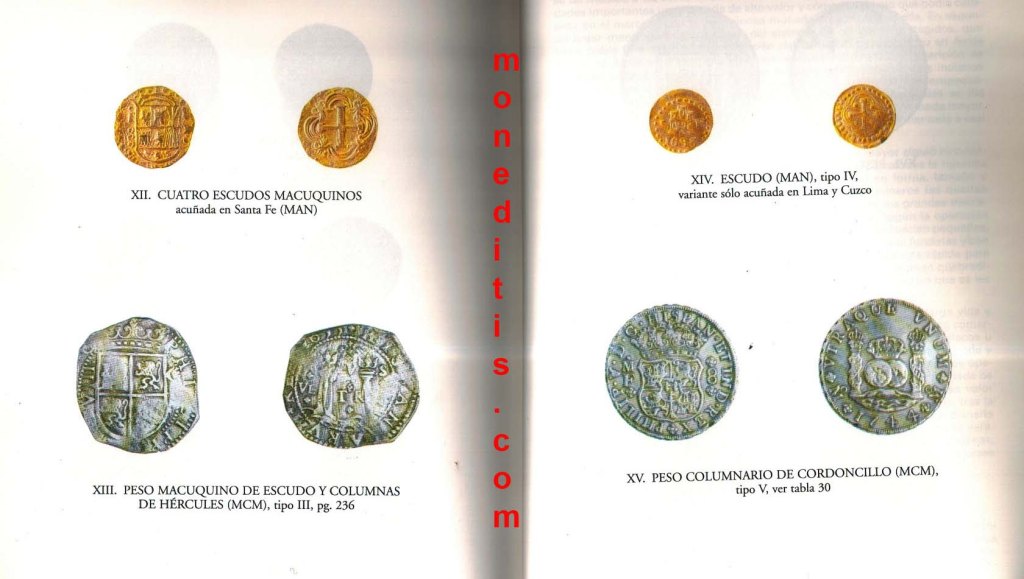
Tengo este libro multi-reseñado, subrayado…Vuelvo a él una y otra vez. Os he dejado imágenes de varias tablas muy útiles y os recomiendo que os hagáis con los dos (2) volúmenes; no os arrepentiréis.

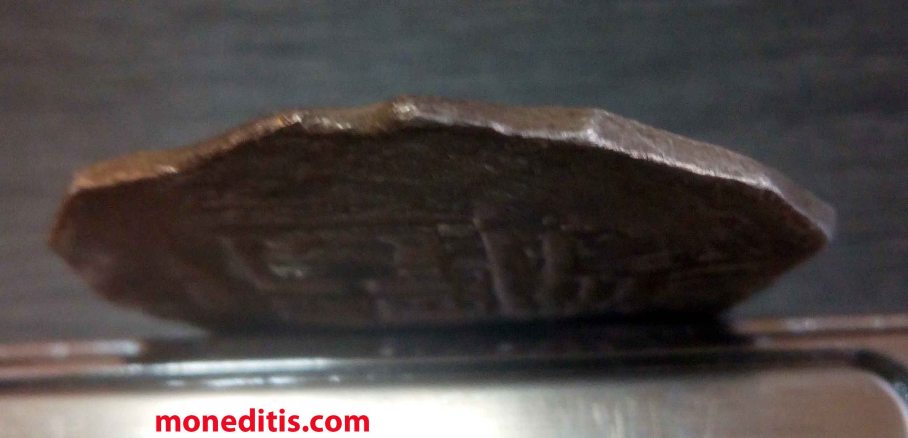
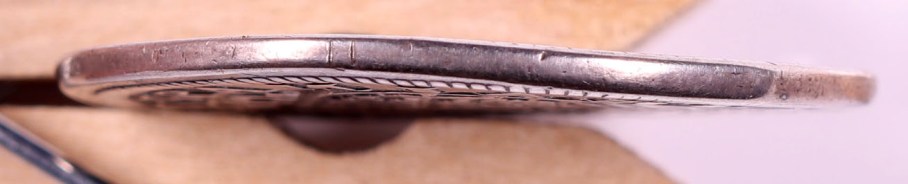
P.S. Piñas y lingotes de fundición

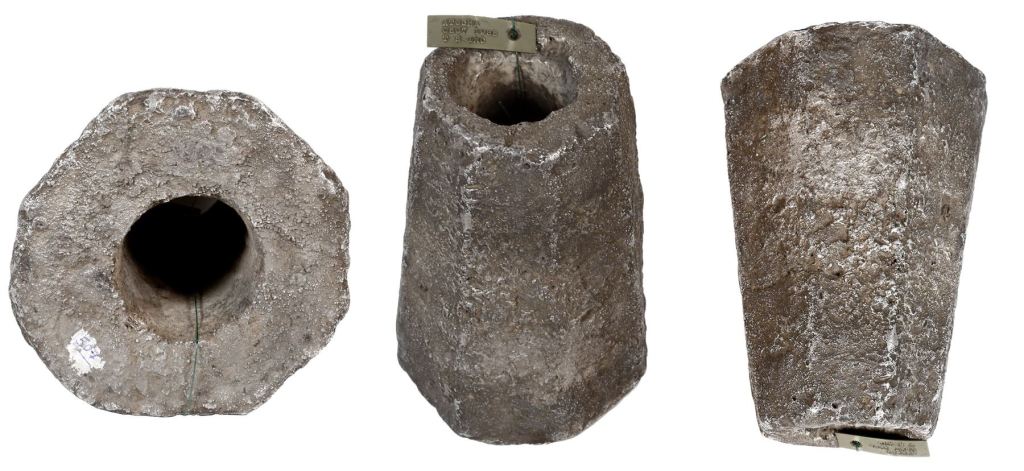
https://auction.sedwickcoins.com/Large-silver-pi-a-ingot-5335-grams-XRF-tested-at-99-silver-rare-ex-Atocha-1622_i52415355

Lingote grande de plata «piña» , 5335 gramos, probado XRF al 99% de plata, raro, ex-Atocha (1622). 7-1/4″ de alto, 3-1/2″ a 5-1/2″ de diámetro, con orificio cilíndrico de 2-1/2 » en el centro. Este es solo el tercer lingote de este tipo que hemos visto en Atocha en una clase conocida como «piñas» por su forma de piña sin corazón, al menos en comparación con los gigantescos lingotes rectangulares que fueron recuperados por cientos de este naufragio. El proceso de refinación del» patio», inventado en México a mediados de la década de 1500 por Bartolomé de Medina, era un método para separar la plata de su mineral por amalgamación con mercurio (mercurio rápido), y describe estos lingotes de» piña » como el paso final donde la plata se calentaba en moldes en forma de campana con varillas centrales. En ese momento, la mayoría de estos lingotes se fundieron en lingotes rectangulares grandes y típicos y se enviaron a la casa de la moneda para su acuñación; pero como los dueños de la mina generalmente necesitaban dinero de inmediato, algunas «piñas» se vendían directamente de la mina, lo que tenía que ser el caso aquí porque ninguno de los extremos muestra marcas, específicamente finura y sellos fiscales. Las superficies no están demasiado corroídas, solo un bonito color plateado uniforme, que tampoco tiene clasificación de Factor de Clase por los Salvadores de Tesoros como las barras grandes. De Atocha (1622), con etiqueta de plástico Fisher original y certificado fotográfico 85A-0507-2.

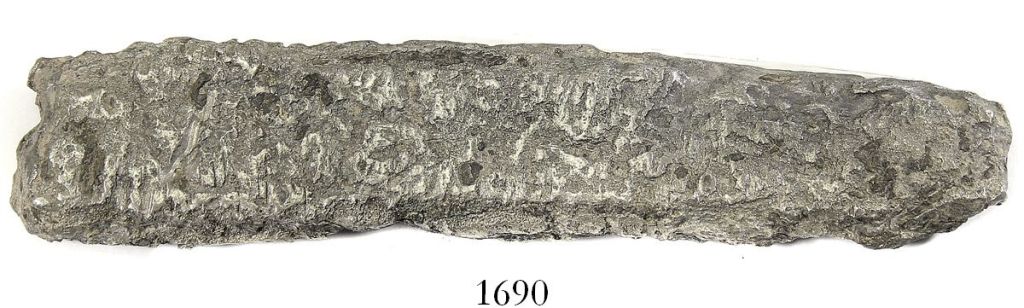
https://auction.sedwickcoins.com/Contraband-silver-ingot-132-grams-Spanish-colonial-1500s-1600s_i17426288

Lingote de plata de contrabando, 132 gramos, colonial español (1500-1600). 132 gramos, aproximadamente 4 «x 3/4″. Lingote extraño, toscamente fundido que se siente liviano pero que prueba como plata, sin marcas, superficies profundamente picadas por la corrosión, una pieza misteriosa que probablemente tiene una historia que contar, su probable peso original antes de la corrosión es igual a aproximadamente 5 » piezas de ocho.»Encontrado en un asentamiento colonial español en el sur del Caribe.

https://auction.sedwickcoins.com/Small-silver-splash-ingot-434-grams_i9879830

Lingote pequeño de plata» splash», 434 gramos. Aprox. 4 «x 6». Un óvalo plano y ordenado de plata brillante (demasiado limpio) con dos tenues sellos fiscales (quintos) que muestran una C coronada de Carlos I, varias gotas de goteo en la parte superior. Del «naufragio del Vellocino de Oro», hundido ca. 1550 en el Caribe norte.

https://auction.sedwickcoins.com/Contraband-silver-wedge-ingot-968-grams-from-the-1715-Fleet_i25872329

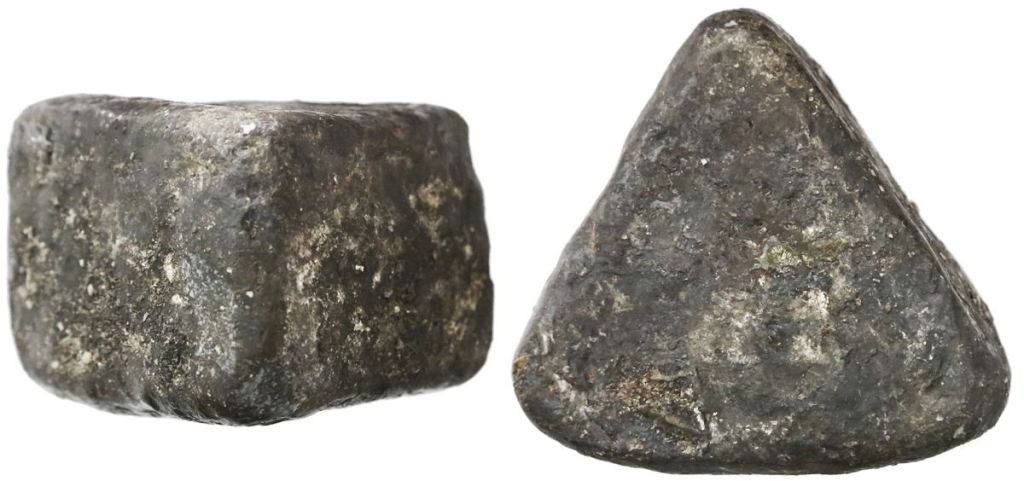
Lingote «cuña» de plata de contrabando, 968 gramos, de la Flota de 1715. 3-1/2″ x 3 «x 2». Lingote triangular grande sin marcas, superficies oscuras como sin limpiar, forma típica supuestamente diseñada para llenar el falso fondo de un barril. De la Flota de 1715.

10 años 2020 – 1

Primera entrada del año 2020

Venimos de aquí:  https://moneditis.com/2025/02/21/10-anos-2019-4/

https://moneditis.com/2025/01/25/10-anos-2019-3/

https://moneditis.com/2024/12/05/10-anos-2019-2/

https://moneditis.com/2024/11/09/10-anos-2019-1/

https://moneditis.com/2024/10/19/10-anos-2018-5/

https://moneditis.com/2024/09/20/10-anos-2018-4/

https://moneditis.com/2024/08/06/10-anos-2018-3/

https://moneditis.com/2024/08/06/10-anos-2018-2/

https://moneditis.com/2024/07/12/10-anos-2018-1/

https://moneditis.com/2024/06/23/10-anos-2017-5/

https://moneditis.com/2024/06/01/10-anos-2017-4/

https://moneditis.com/2024/05/25/10-anos-2017-3/

https://moneditis.com/2024/04/27/10-anos-2017-2/

https://moneditis.com/2024/04/11/10-anos-2017-1/

https://moneditis.com/2024/03/22/10-anos-2016-4/

https://moneditis.com/2024/01/25/10-anos-2016-3/

https://moneditis.com/2024/01/25/10-anos-2016-2/

https://moneditis.com/2024/01/25/10-anos-2016-1/

https://moneditis.com/2023/12/16/10-anos-2015-5/

https://moneditis.com/2023/12/08/10-anos-2015-4/

https://moneditis.com/2023/11/25/10-anos-2015-3/

https://moneditis.com/2023/11/18/10-anos-2015-2/

https://moneditis.com/2023/11/04/10-anos-2015-1/

https://moneditis.com/2023/10/28/10-anos-2014-4/

https://moneditis.com/2023/10/14/10-anos-2014-3/

https://moneditis.com/2023/09/30/10-anos-2014-2/

https://moneditis.com/2023/09/16/10-anos-2014-1/

https://moneditis.com/2023/08/30/10-anos-2013/

Vamos a por la vigésimo novena (29) entrada conmemorativa; el enlace inferior conecta con la parte del blog tratada, a partir de enero de 2020

https://moneditis.com/page/27/

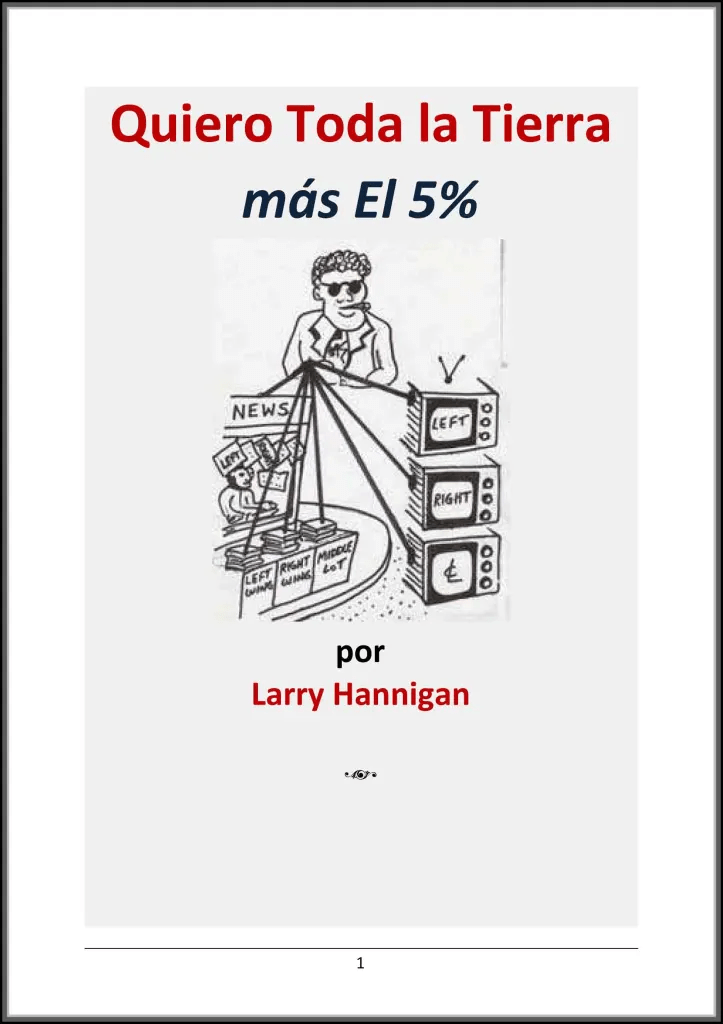
La primera entrada del 2020  ¡Feliz 2020!  contiene la fábula de Fabián «Quiero toda la Tierra más el 5%» de obligada lectura para todos; ¡cuántos quebraderos de cabeza me hubiera ahorrado si hubiese leído esta fábula de chaval!  Os vuelvo a dejar el texto por aquí

Os dejo aquí el pdf  quiero-toda-la-tierra-mas-el-5

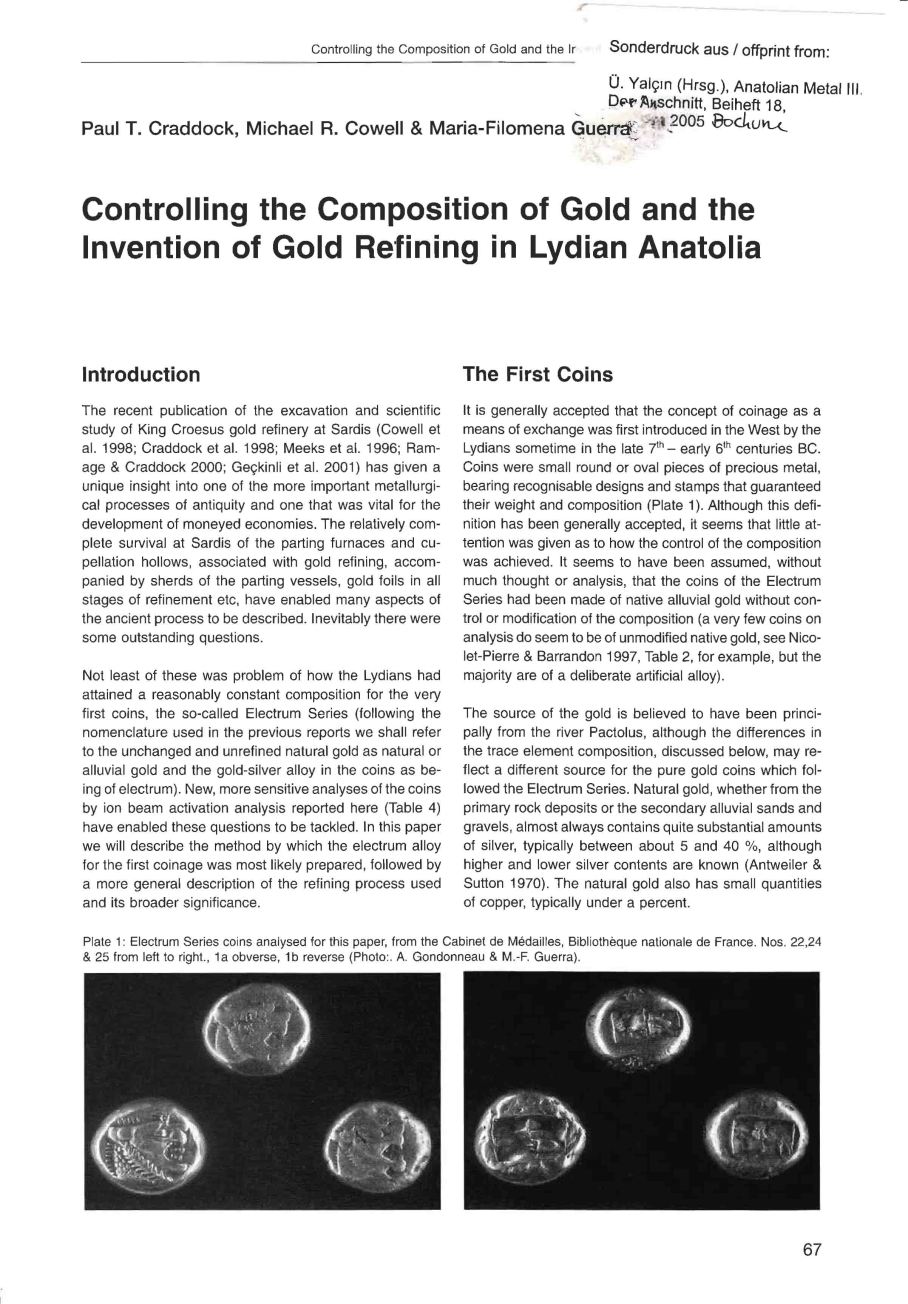
Paper de Craddock, Cowell y Guerra: ¡unos cracks! sobre el Au/Ag/ Electrum de las primeras monedas lidias: datos analíticos y morfológicos, entre otros. https://moneditis.com/2020/01/08/composition-of-gold-and-the-lnvention-of-gold-refining-in-lydian-anatolia/

Esta primera entrada del 2020 ha empezado muy fuerte, como lo fue el año en si. 

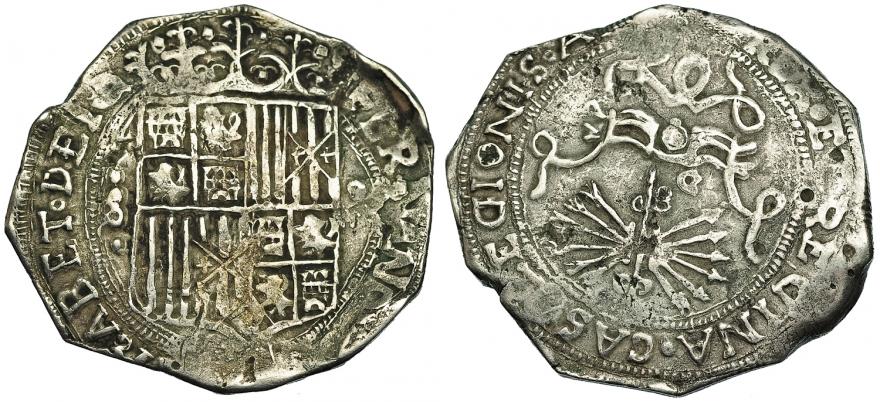
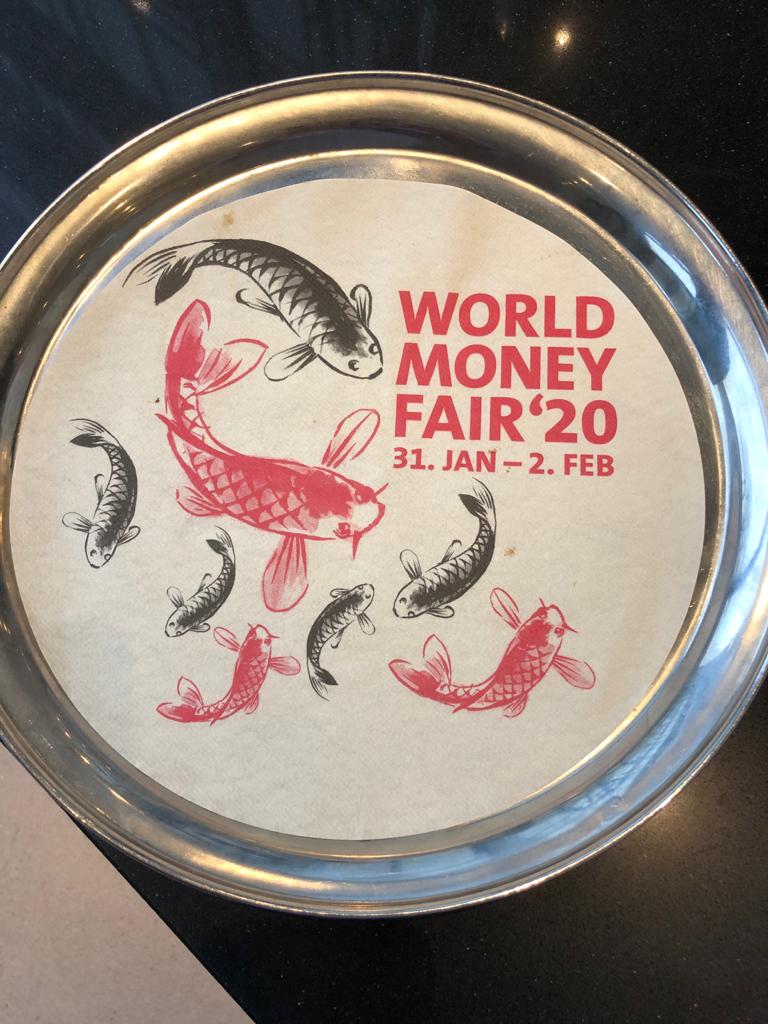
Sigo con  Козерог / Capricornio , el siguiente signo zodiacal (segundo tratado hasta ese momento), una subata de Vico con unos reales de a ocho sevillanos falsos a nombre de los Reyes Católicos   Vico 8 reales Sevilla Reyes Católicos FALSOS  , convención en Madrid   Convención 24 enero Madrid  y ¡la World Money Fair (WMF) 2020! como siempre, en Berlín  https://moneditis.com/2020/01/31/berlin-world-money-fair-2020/ 

Montones de fotos, catálogos e información sobre la mayor feria numismática en suelo europeo, siempre a principios de cada año

Moneda inédita en subasta   8 reales macuquinos Sevilla y Lima para posible XRF   siguiente horóscopo (van tres)  Водолей / Acuario

«Su espíritu es poderoso, sabe ver hacia el futuro con libertad intelectual y de espíritu y posee una gran imaginación. Signo de aire, dominado por Saturno y Urano, a veces es algo melancólico y cae fascinado por lo misterioso, lo que le lleva a ser poco práctico. Es altruista y le gusta probar cualquier clase de innovación. Afectivamente es cautivador, pero no soporta la monotonía.»

Estudio analítico detallado sobre monedas de plata de entre los siglos XVI a XIX, muchas del Imperio español, rescatadas de diversos pecios en las costas australianas. Interesantes conclusiones

https://moneditis.com/2020/02/22/analysis-silver-coins-16th-to-19-th-century/  

Voy terminando.    Рыбы / Piscis  (cuarto signo)   Monedas que me gustan…  y   https://moneditis.com/2020/03/14/%d1%80%d1%83%d0%b1%d0%bb%d1%8c-1834-rublo-1834/  con enlaces a rublos de 1828, 1831 y 1854

Аверс: по кругу вдоль края монеты разделенная вверху розеткой надпись «ЧИСТОГО СЕРЕБРА 4 ЗОЛОТНИКА 21 ДОЛЯ», в середине в круге из точек герб Российской империи, внизу слева и справа от хвоста орла инициалы минцмейстера «НГ» (Николай Грачев).

Anverso: ЧИСТОГО СЕРЕБРА 4 ЗОЛОТНИКА 21 ДОЛЯ

H  Г  Николай Грачев – Nikolai Grachev – минцмейстера / Münzmeister / Jefe de ceca

Lo dejamos aquí  https://moneditis.com/page/26/  en marzo de 2020. 

En la próxima entrada seguiremos con horóscopo y rublos

10 años 2019 – 2

Segunda entrada del año 2019

Venimos de aquí:  https://moneditis.com/2024/11/09/10-anos-2019-1/ 

https://moneditis.com/2024/10/19/10-anos-2018-5/

https://moneditis.com/2024/09/20/10-anos-2018-4/

https://moneditis.com/2024/08/06/10-anos-2018-3/

https://moneditis.com/2024/08/06/10-anos-2018-2/

https://moneditis.com/2024/07/12/10-anos-2018-1/

https://moneditis.com/2024/06/23/10-anos-2017-5/

https://moneditis.com/2024/06/01/10-anos-2017-4/

https://moneditis.com/2024/05/25/10-anos-2017-3/

https://moneditis.com/2024/04/27/10-anos-2017-2/

https://moneditis.com/2024/04/11/10-anos-2017-1/

https://moneditis.com/2024/03/22/10-anos-2016-4/

https://moneditis.com/2024/01/25/10-anos-2016-3/

https://moneditis.com/2024/01/25/10-anos-2016-2/

https://moneditis.com/2024/01/25/10-anos-2016-1/

https://moneditis.com/2023/12/16/10-anos-2015-5/

https://moneditis.com/2023/12/08/10-anos-2015-4/

https://moneditis.com/2023/11/25/10-anos-2015-3/

https://moneditis.com/2023/11/18/10-anos-2015-2/

https://moneditis.com/2023/11/04/10-anos-2015-1/

https://moneditis.com/2023/10/28/10-anos-2014-4/

https://moneditis.com/2023/10/14/10-anos-2014-3/

https://moneditis.com/2023/09/30/10-anos-2014-2/

https://moneditis.com/2023/09/16/10-anos-2014-1/

https://moneditis.com/2023/08/30/10-anos-2013/

Vamos a por la vigésimo sexta (26) entrada conmemorativa; el enlace inferior conecta con la parte del blog tratada, a partir de marzo de 2019

https://moneditis.com/page/30/

5 рублей 1902 / 5 rublos 1902 / CCCP / URSS / Rusia   5 rublos reacuñación soviética

https://moneditis.com/2019/03/15/imperio-espanol-europa-duros-carlos-ii/  Carlos II; ese desconocido y enigmático rey de las Españas

Con  CKK moneditas para todos marzo 2019 convención  y  Ceca de Lima. 450 años  en su post scriptum, impresionante exposición del oro inca en el Museo Etnográfico de San Petersburgo

московского двора россискоi рубль ея i в (императорского величества)

Y entre medias, rublo de 1726: Catalina I  https://moneditis.com/2019/03/25/rublo-1726-%d1%80%d1%83%d0%b1%d0%bb%d1%8c-1726/

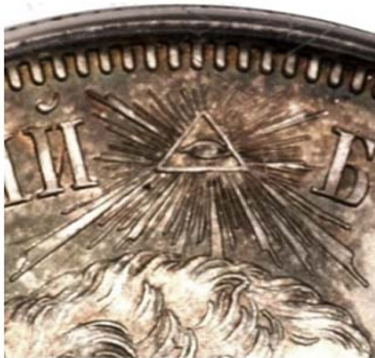
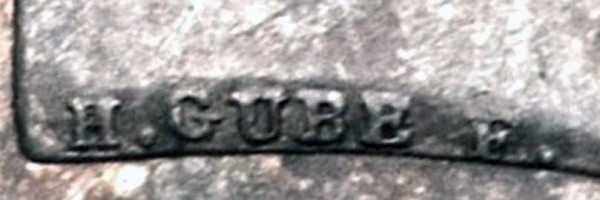
https://moneditis.com/2019/04/05/rublo-1839-borodino-%d1%80%d1%83%d0%b1%d0%bb%d1%8c-1839-h-gube-f/ Este rublo se acuñó en tiempos de Nicolas I, 1839, hijo de Alejandro I, y conmemora la construcción de una capilla en recuerdo a los caídos en la batalla en la batería Rayevsky, colina desde la que se divisaban a este y oeste las posiciones del primer, segundo y tercer cuerpo del ejército ruso.

ВТБ Банк / Banco VTB  y   Dobles y Triples Ducatones Felipe IV  continúan con la Pascua Ortodoxa y sus huevos

https://moneditis.com/2019/04/20/10-%d1%80%d1%83%d0%b1%d0%bb%d0%b5%d0%b9-%d0%b7%d0%be%d0%bb%d0%be%d1%82%d0%be-%d0%bd%d0%b8%d0%ba%d0%be%d0%bb%d0%b0%d0%b9-ii-10-rublos-oro-nicolas-ii/  con un par de post scriptum interesantes

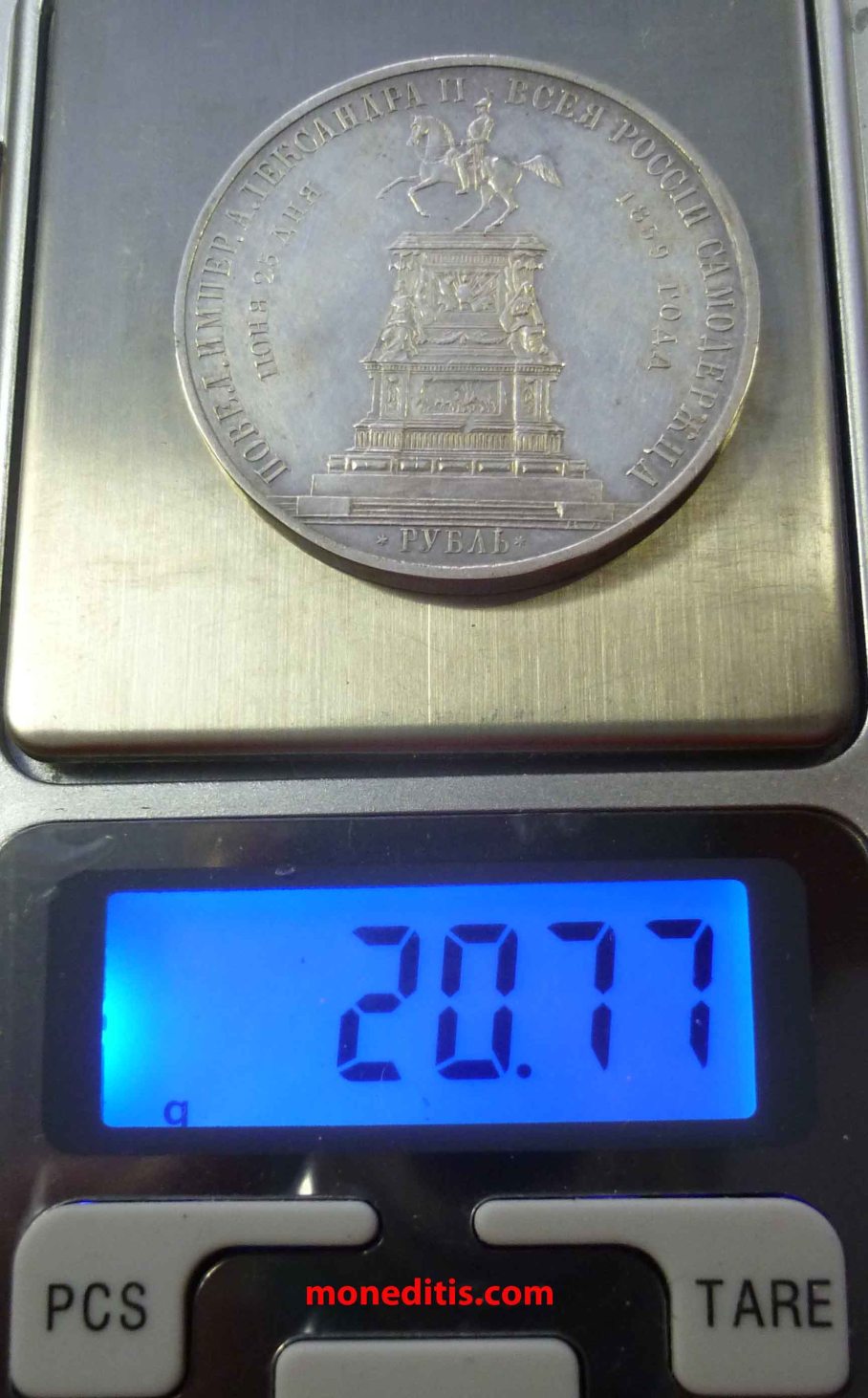
Con  Huevos de Pascua / Пacxa   y   Rublo 1859 / Рубль 1859    nos plantamos en mayo de 2019 

La emisión fue programada para el día de la inauguración del monumento el 25 de junio de 1859 (cumpleaños de Nikolai Pavlovich – Nicolás I). Hay dos variantes del retrato. El primero, más plano, se distingue por el relieve fino del pelo y cuello estrecho. El 12 de junio se emitieron 5 monedas y se ordenó la fabricación de 25.000 piezas y, si no fuera suficiente, 25.000 más.

El monumento es una estatua ecuestre de seis metros de Nicolás I de P. K. Claude, sobre pedestal. El emperador está representado en uniforme de etiqueta de la guardia del regimiento ecuestre. Cuatro bajorrelieves, situados en el pedestal, representan acontecimientos emblemáticos del reinado de Nicolás I: la rebelión de los decembristas en 1825; la revuelta del holocausto en 1831 en la Plaza Sennaya; el premio de M. M. Speransky, que reunió y publicó en 1832 el «Arco de las leyes del Imperio ruso» y la inauguración por el Emperador del puente del ferrocarril San Petersburgo – Moscú en 1851.

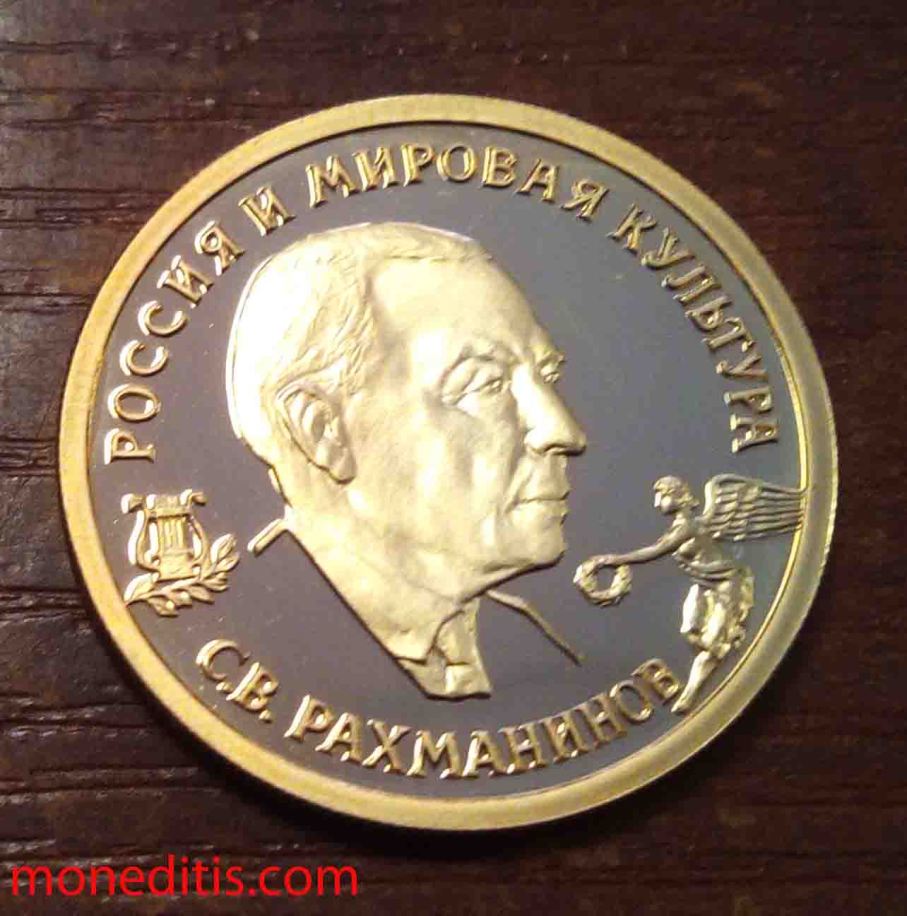
Центральный Банк РФ / Banco Central de Rusia  y   50 рублей Рахманинов / 50 rublos Rajmáninov

Termino esta entrada a mediados de mayo de 2019 explicando el proceso de fabricación de monedas a lo largo de la historia   https://moneditis.com/2019/05/15/fabricacion-de-monedas-detalles-y-habilidades/

Nos hemos quedado aquí   https://moneditis.com/page/29/

La siguiente entrada de 2019, la tercera, comenzará con un rublo de 1765, Zarina Catalina II

10 años 2018 – 3

Seguimos con las entradas conmemorativas por los diez (10) años del blog

Venimos de aquí:  https://moneditis.com/2024/08/06/10-anos-2018-2/

https://moneditis.com/2024/07/12/10-anos-2018-1/

https://moneditis.com/2024/06/23/10-anos-2017-5/

https://moneditis.com/2024/06/01/10-anos-2017-4/

https://moneditis.com/2024/05/25/10-anos-2017-3/

https://moneditis.com/2024/04/27/10-anos-2017-2/

https://moneditis.com/2024/04/11/10-anos-2017-1/

https://moneditis.com/2024/03/22/10-anos-2016-4/

https://moneditis.com/2024/01/25/10-anos-2016-3/

https://moneditis.com/2024/01/25/10-anos-2016-2/

https://moneditis.com/2024/01/25/10-anos-2016-1/

https://moneditis.com/2023/12/16/10-anos-2015-5/

https://moneditis.com/2023/12/08/10-anos-2015-4/

https://moneditis.com/2023/11/25/10-anos-2015-3/

https://moneditis.com/2023/11/18/10-anos-2015-2/

https://moneditis.com/2023/11/04/10-anos-2015-1/

https://moneditis.com/2023/10/28/10-anos-2014-4/

https://moneditis.com/2023/10/14/10-anos-2014-3/

https://moneditis.com/2023/09/30/10-anos-2014-2/

https://moneditis.com/2023/09/16/10-anos-2014-1/

https://moneditis.com/2023/08/30/10-anos-2013/

Vamos a por la vigésimo segunda (22) entrada conmemorativa; el enlace inferior conecta con la parte del blog tratada, a partir de junio del 2018

https://moneditis.com/page/34/

https://moneditis.com/2018/06/05/%d0%b8%d1%81%d0%bf%d0%b0%d0%bd%d1%81%d0%ba%d0%b8%d0%b9-%d0%bd%d1%83%d0%bc%d0%b8%d0%b7%d0%bc%d0%b0%d1%82%d0%b8%d1%87%d0%b5%d1%81%d0%ba%d0%b8%d0%b9-finde/

Madrid y Costa del Sol (mercadillos y convención). ¡Llegando el verano de 2018!

Tras entrada sobre la Convención Numismática Internacional en Madrid el 15 y 16 de junio y el Mundial de Fútbol en Rusia – monedas y billetes – unos reales de a ocho (8) falsos

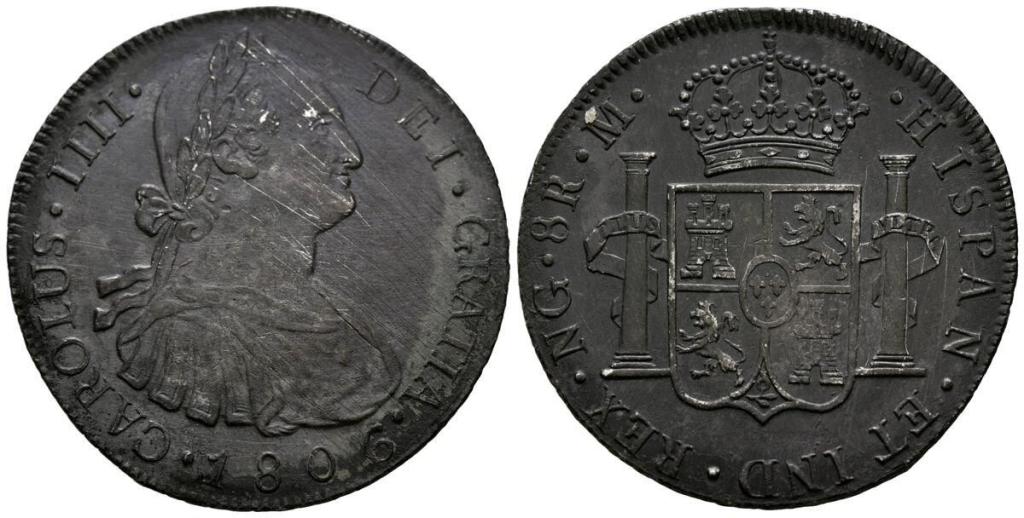
https://moneditis.com/2018/06/20/8-reales-1803-lima-falsos/

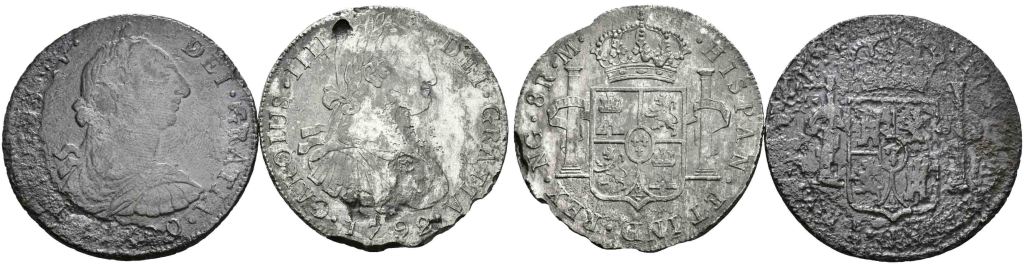
Estos ocho reales limeños de Carlos IV 1803 tienen toda la pinta de ser falsos, en el sentido de no haber sido acuñados por la Corona Española sino, muy probablemente, por los hijos de la Gran Bretaña en Birmingham y/o Sheffield

Posteriormente, entradas sobre subasta con columnario limeño, libro veraniego – la leyenda del ladrón, Juan Gómez-Jurado – y entrada sobre criptomonedas y su coleccionismo

https://moneditis.com/2018/07/10/coleccionar-cryptocurrencies-criptomonedas/

Expongo mis dudas sobre la viabilidad de muchas «shitcoins» de la época…algunas desaparecidas en la actualidad

Más entradas: simetría – La ecuación jamás resuelta , Mario Livio – y más reales de a ocho

https://moneditis.com/2018/07/28/agosto-canicular-8-reales-i/

Estimate: 50’000 USD   |   Starting price: 25’000 USD

Danish Asiatic Company. Christian VII Trade Piastre 1777 AU55 NGC, Kongsberg mint, KM639.2, Dav-412, Salvesen-52. An extraordinary offering that features the crowned arms of Denmark, Norway, and Sweden across the obverse. The reverse presents the crowned, globe-shaped arms of Denmark and Norway between two pillars with the island names of ISLAN, GRÖNLAN, and FERÖ below. Thick, cobalt-dove patina covers the entirety of the planchet, with cordovan coloring at the legends and original luster that gleams from the expanses. The strike has been rendered with authority and any effects of handling remain well concealed beneath the darkened patination. Struck for trade in the Orient, the design of this historically important «Greenland Dollar» was inspired by the Spanish colonial pillar 8 Reales, and was issued in the year that the Danish Asiatic Company ceded Asian trade rights to the Danish crown. A scarce offering in total, with Salvesen reporting a mintage figure of 21 known pieces, 12 of which are in museums. Ex. Millennia CollectionHID05401242017

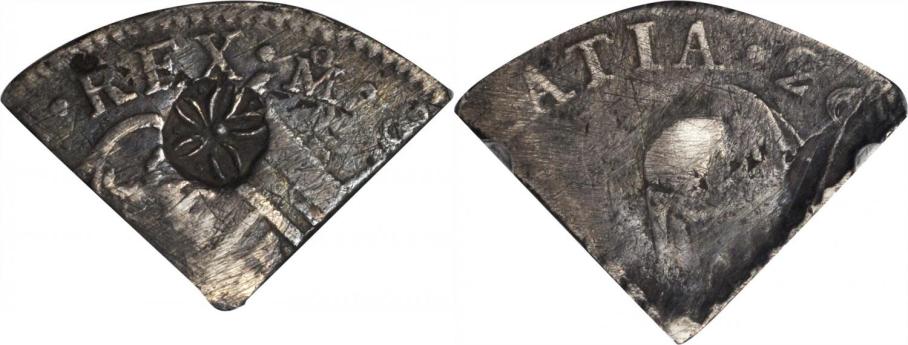
CURACAO. 3 Reaals (18 Stivers or Guillotine), ND (ca. 1800-01). PCGS Genuine–Tooled, Fine Details Secure Holder.
6.60 gms. KM-7; Prid-pg. 251 Fig. 25; Scholten-1368a. «Star» or Rosace of five petals countermark applied to reverse of a cut 1/4 Dollar with crenated edges of 1793-MoFM bust 8 Reales of Charles IIII(IV). During the governorship of J. K. Lauffer small silver coinage was obtained by cutting whole Spanish Dollars into quarters. A quantity of 7,000 Dollars were cut into equal parts by goldsmith H. J. Hoyer and were declared current at 3 Reaals or 18 Stivers. The local name given to these as referred to in public notices was «Guillotinos». A public notice of 3rd March 1801 warned against forgeries. VERY RARE and very interesting, much more so than the later more common British occupation issues of cut 1/5 Dollars. It should be noted that the indent on the reverse next to the date is identical to the example plated in Fred Pridmore’s ground breaking work «The Coins of the British Commonwealth of Nations Part 3 West Indies». The countermark is well placed and bold. Though the holder indicates tooling this is not accurate, numerous scratches are present on both the obverse and reverse from long ago now toned over. The date and KM number listed on the PCGS insert are incorrect. Dark gray to charcoal toning throughout with hints of blue that pop out when tilted in the light. Another treat for the specialist of West Indies cut and countermarked issues. Countermark VF Details, host coin
PCGS Genuine–Tooled, Fine Details Secure Holder.

y II  https://moneditis.com/2018/08/07/agosto-canicular-8-reales-ii/

y III  https://moneditis.com/2018/08/14/agosto-canicular-8-reales-iii/

Entradas posteriores sobre la Plaza mayor de Madrid, FAO y termino esta entrada con un ponderal de 8 reales de Felipe V, concluyendo también el verano

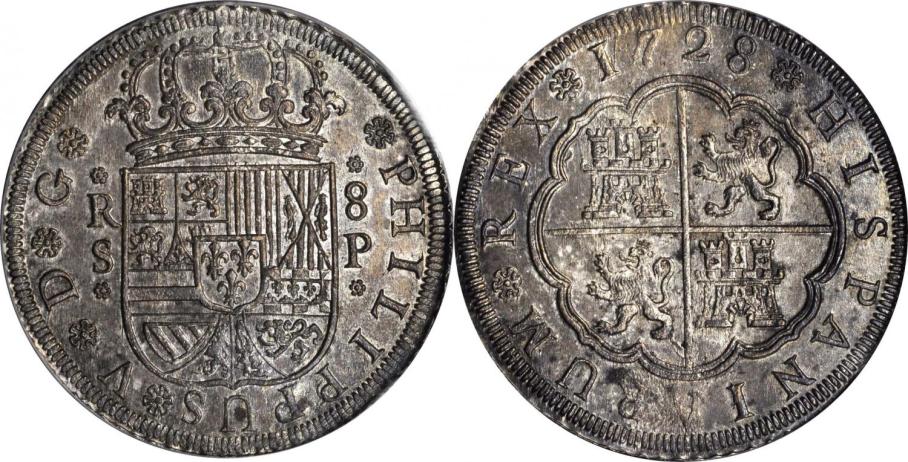
https://moneditis.com/2018/09/05/ponderal-8-reales-felipe-v/

Lo dejo aquí; 5 de septiembre de 2018

https://moneditis.com/page/33/

Comenzaré la cuarta (4ª) entrada sobre este 2018 con coleccionables – Historia de la Peseta

8 Escudos 1762 Carlos III Lima

Enlace a mi tienda en ebid. Iré subiendo más moneditas de mi colección

https://stores.ebid.net/moneditis

—————————————————————————————————————————————

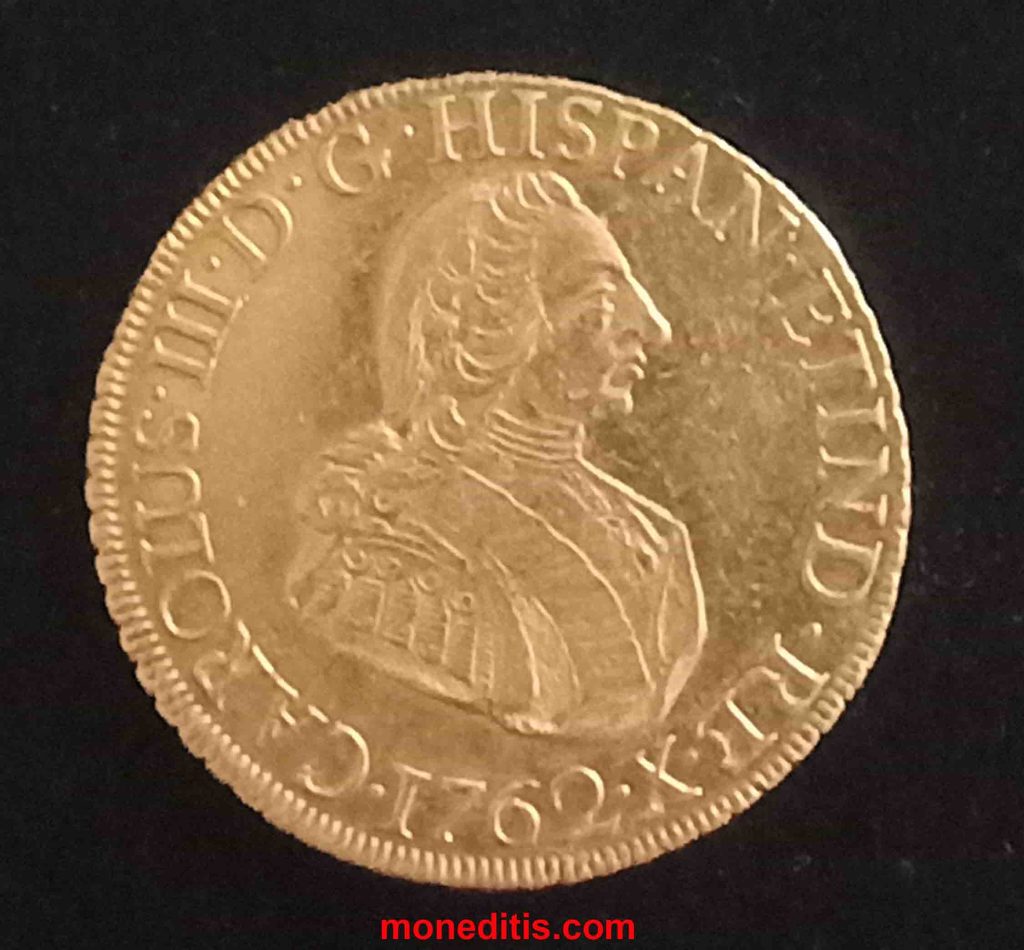
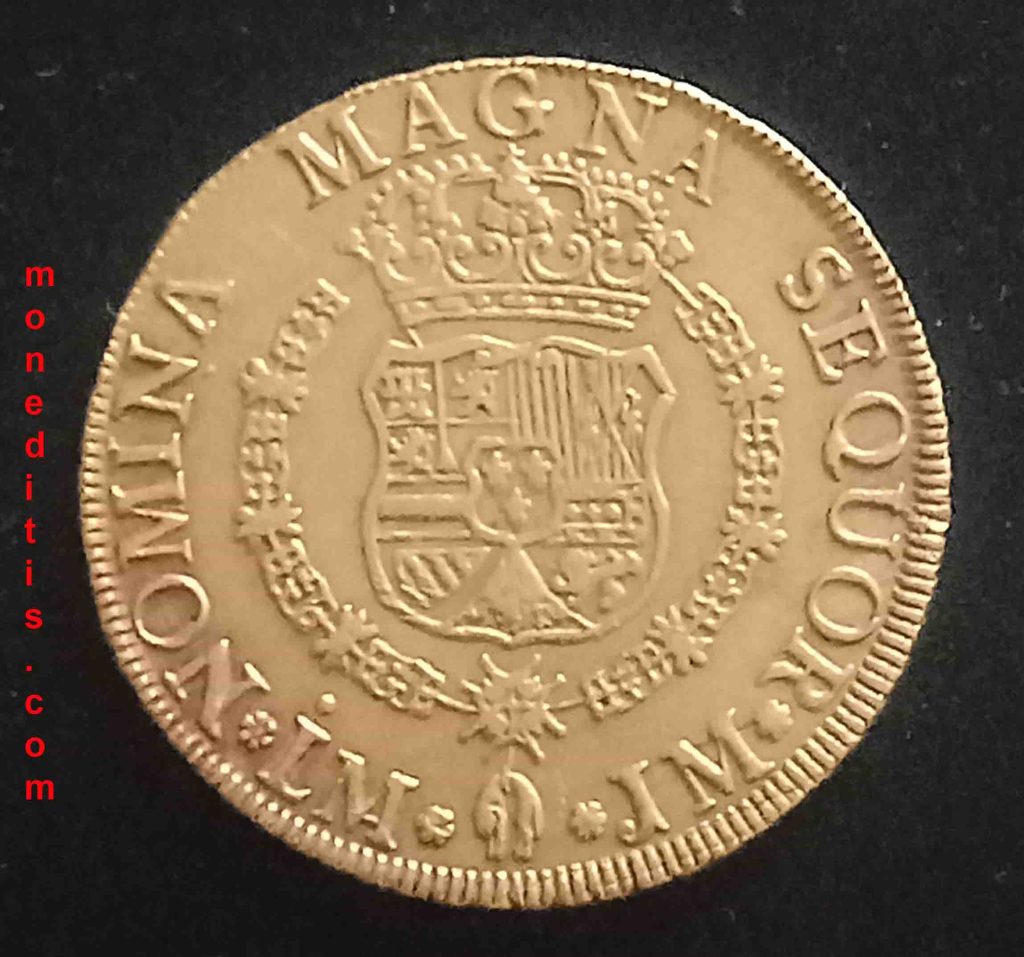
8 escudos 1762 Lima de Carlos III, hijo de Felipe V como sus antecesores Luis I y Fernando VI

https://es.wikipedia.org/wiki/Carlos_III_de_Espa%C3%B1a

                                                                       1762

Pesa 26,98 g, tiene algunas marquitas y una breve limpieza y en el canto aparece una falla en la cadeneta que se aprecia a duras penas en el siguiente vídeo

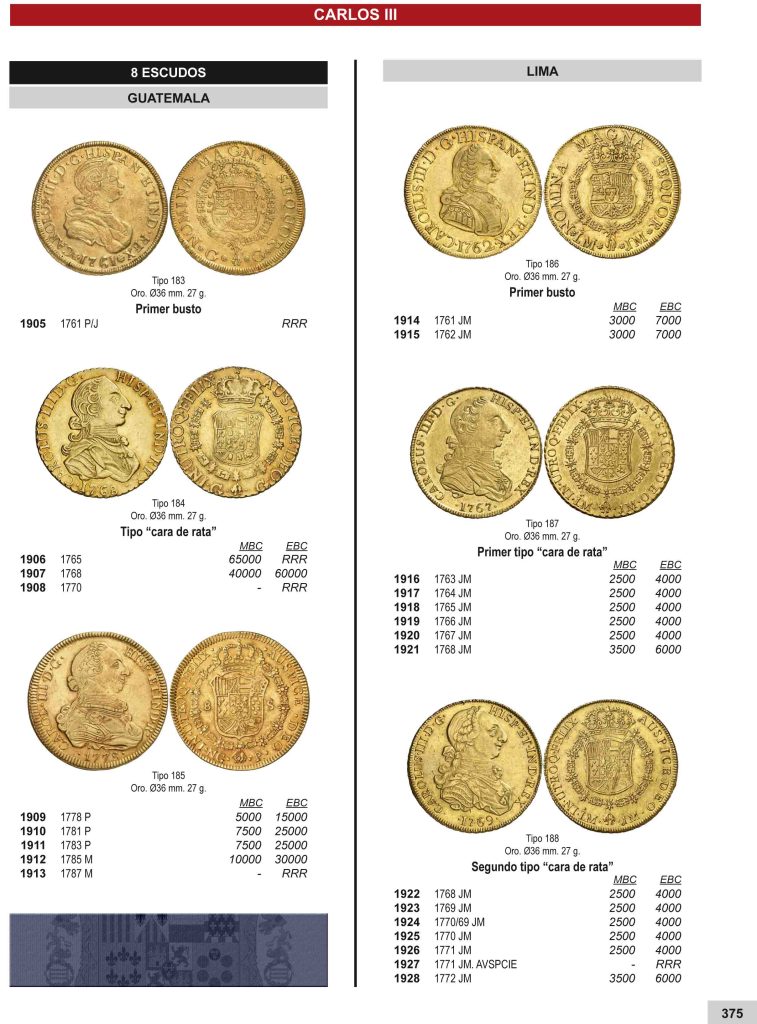
Y con la página del catálogo de Áureo referente a este 8 escudos termino esta entrada. ¡Feliz Navidad!

Algunos 8 reales que no me gustan

Enlace a mi tienda en ebid. Iré subiendo más moneditas de mi colección

https://stores.ebid.net/moneditis

—————————————————————————————————————————————

Miro pocas subastas patrias; la internacionalización y su trato diferencial es lo que tiene. Además, los 8 reales prefiero comprarlos en mano, ya que llevo años coleccionándolos y tengo mis «proveedores» 😉

Aún así, Ibercoin me parece honesta (casa de subastas / personal) por lo que junto con algún subastero patrio más que también sigo por su demostrado buen hacer y que aparece en este blog, hace que en alguna ocasión me permita comentar monedas de sus subastas. Por eliminación, de los que no comento es que no me gustan por alguna razón (amenazas, prohibición de pujas…) y no pierdo mi tiempo con ellos. Fácil. 

https://www.numisbids.com/n.php?p=lot&sid=6588&lot=1267

Lot 1267  Starting price: 50 EUR  Current bid: None
 
CARLOS III (1759-1788). 8 Reales (Ar. 26,82g/39mm). 1773. México FM. (Cal-2019-1107). BC+.
 
Acuñación floja con desgaste irregular, gráfila no concluyente, arte raro a la vista, tipos (letras) deslavazados – IND R EX – leones y castillos de aquella manera, busto diluido aunque con sonrisa marcada…
 
Lot 1312  Starting price: 80 EUR  Current bid: None
 
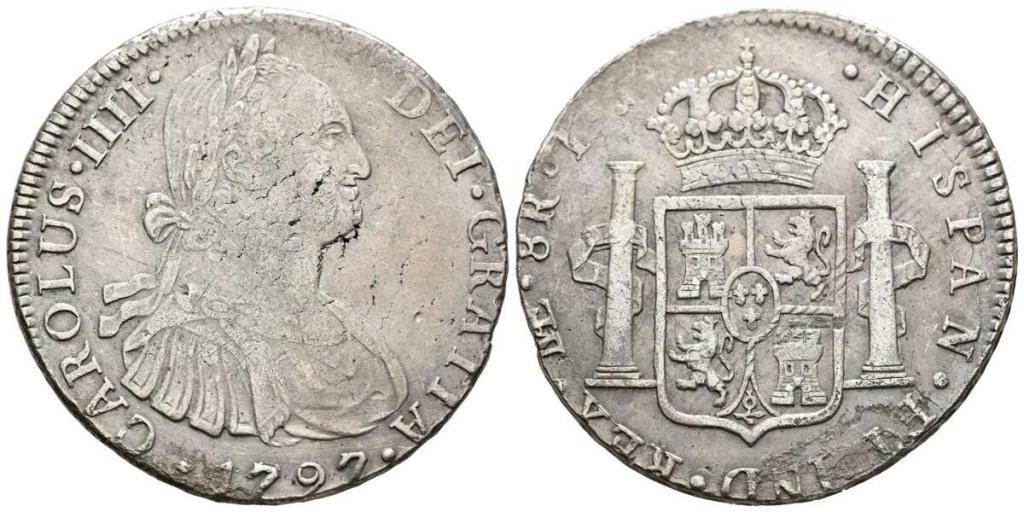
CARLOS IV (1788-1808). 8 Reales. (Ar. 26,35g/39mm). 1797. Lima IJ. (Cal-2019-951). MBC-.
 
En la descripción no se menciona que haya sido «mermado» o limado el cospel de este 8 reales, por lo que entiendo que el cordoncillo permanece intacto y el descentrado e «irregularidad» podría ser fruto del mal hacer de la ceca limeña…o del falsario de turno, sea de época o contemporáneo; quizá Birmingham, quizá China, quizá…
 
 
image01313
Lot 1313  Starting price: 50 EUR  Current bid: None
 
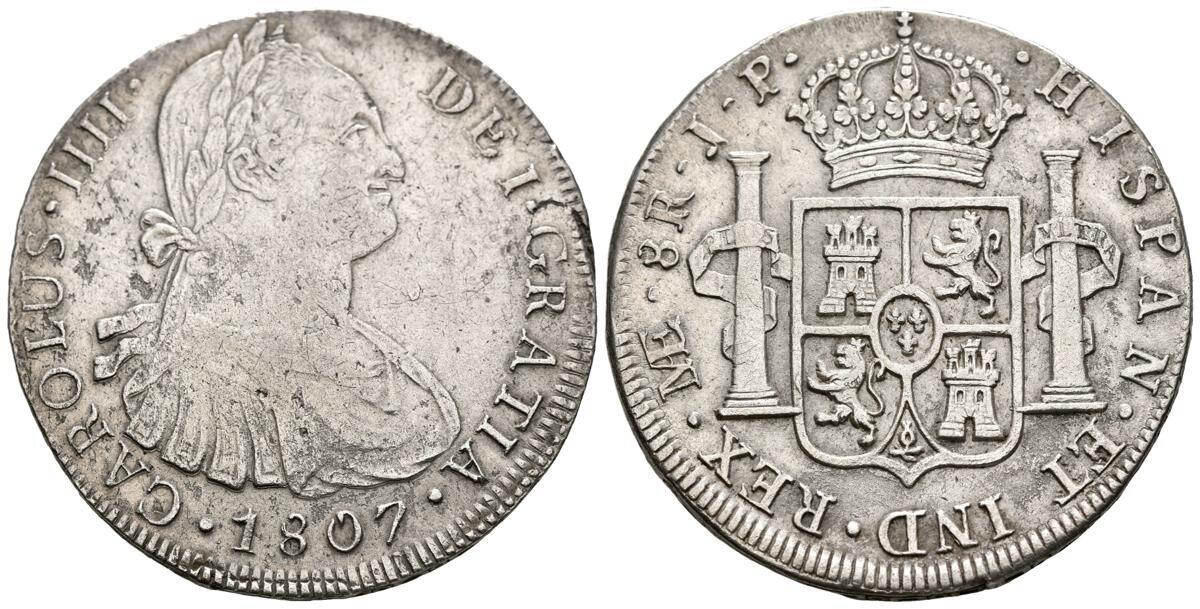
CARLOS IV (1788-1808). 8 Reales (Ar. 26,48g/39mm). 1807. Lima JP. (Cal-2019-927). MBC
 
Este lo dejo a vuestro seguro buen saber y entender, ya entrenado en las dos (2) anteriores monedas
 
Hay varios duros con pátina obscura o muy obscura; para mi son siempre monedas a valorar de cerca (lotes 1310, 1311, 1315, 1325…)

https://www.numisbids.com/n.php?p=lot&sid=6588&lot=1401

Lot 1401 Starting price: 30 EUR  Current bid: None
 
FERNANDO VII (1808-1833). 8 Reales. (Ar. 26.70g/39mm). 1817. México JJ. (Cal-2019-1332).BC+/MBC-. Pátina negra.
 
Este duro tiene mala, mala pinta
 
No sigo porque este análisis no pretende ser exhaustivo y porque sin métodos analíticos mediante sólo puedo especular sin llegar a conclusión alguna. Dejo a vuestro criterio otras monedas de esta u otras subastas para su detallado análisis visual 😉

P.S.  https://coinsweekly.com/

https://coinsweekly.com/new-york-prosecutor-to-press-charges-against-richard-beale-roma-numismatics/

8 escudos Carlos III 1774 Lima

Enlace a mi tienda en ebid. Iré subiendo más moneditas de mi colección

https://stores.ebid.net/moneditis

—————————————————————————————————————————————

Otro 1774, esta vez de Lima. Aquí  https://moneditis.com/2022/08/14/8-escudos-1774-carlos-iii-sevilla/  8 escudos 1774 Sevilla

Estos 8 escudos no son «cara de rata» (1763 a 1772 – 2 tipos), cariñoso apelativo a los anteriores bustos acuñados en Lima, entre otras cecas (Guatemala, Madrid, México, Nuevo Reino, Santiago y Sevilla), de Carlos III, pero siguen siendo historia hispano-americana.

CAROL III DG HISP ET IND R AÑO (Carlos III por la gracia de Dios rey de las Españas y las Indias) alrededor del busto del rey a derecha

IN UTROQ FELIX AUSPICE DEO ceca (Lima) y ensayadores (MJ –  Manuel Iglesia Abarca y Juan Martínez de Roxas). En uno y otro (mundo) felices bajo la mirada de Dios – alrededor de un escudo de armas coronado entre 8 y S rodeado del toisón de oro.

canto algo dañado

1774 es el primer año completo del ensayador Juan Martínez de Roxas en la ceca de Lima. En 1773 falleció José Rodríguez Carasa.

8 reales Lima 1795 Carlos IV dudosos ¿falsa? Subasta Silicua

Enlace a mi tienda en ebid. Iré subiendo más moneditas de mi colección

https://stores.ebid.net/moneditis

—————————————————————————————————————————————

No me gustan estos 8 reales Lima 1795 Carlos IV

1795Carlos IV (1788-1808)Lima8 realesIJAgBonita pátinaEBC / MBC+. Est.60.

https://www.silicua.com/es/lote/FEBESP21-2001-2001/69-248-monarquia-espanola

Pertenece a la Casa de Subastas Silicua

Ahora pongo fotos de los detalles por si aún no habéis detectado nada raro. No leo peso/masa de la moneda en su descripción

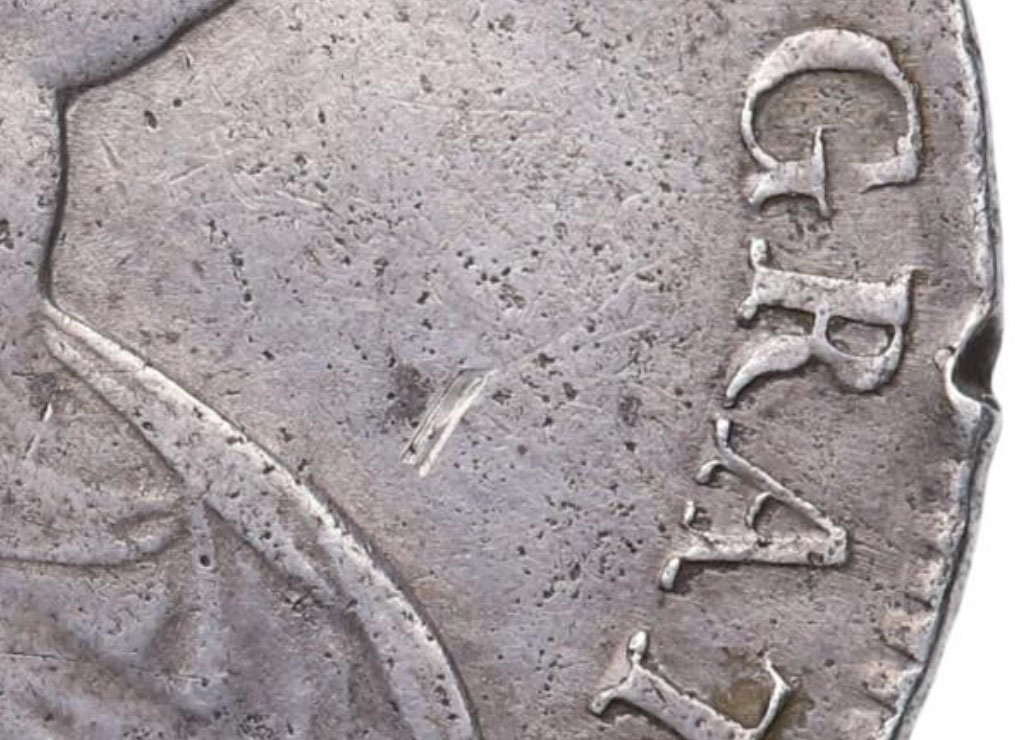
Parece fundida por las burbujas de aire en superficie, además de tipografía y detalles generales de definición «raros». No digo nada de la marca del canto que podría ser la entrada de metal en el molde de cera…especulando  😉

P.S. Este columnario en Aureo debería pesar, al menos, 1 gramo más (si es que no hay un error en la cifra 25,74 g dada)

Estimate: 500 EUR

https://www.numisbids.com/n.php?p=lot&sid=4518&lot=1210

Creo reconocer algo de oxidación y retoques aquí y allá…Dudo…y por ello, no la compraría

Subastas Reales Rusas

Enlace a mi tienda en ebid. Iré subiendo más moneditas de mi colección

https://stores.ebid.net/moneditis

————————————————————————————————————————————–

Noviembre es un mes intercalado entre octubre y diciembre…de paso, por el medio… por lo que voy a echar un vistazo a las subastas de Sedwick y Konros, USA y Rusia, a falta de nada mejor que hacer… numismáticamente hablando  🙂  Añadir que, por la cercanía de la Navidad, todos los años desde hace unos cuantos, siempre hay una gran concentración de subastas por estas fechas; mera política comercial.
https://www.numisbids.com/n.php?p=sale&sid=4266

https://auction.sedwickcoins.com/auctionlist.aspx

Multitud de lingotes, macuquinas, peluconas, galanos, onzas…

https://www.numisbids.com/n.php?p=lot&sid=4266&lot=21
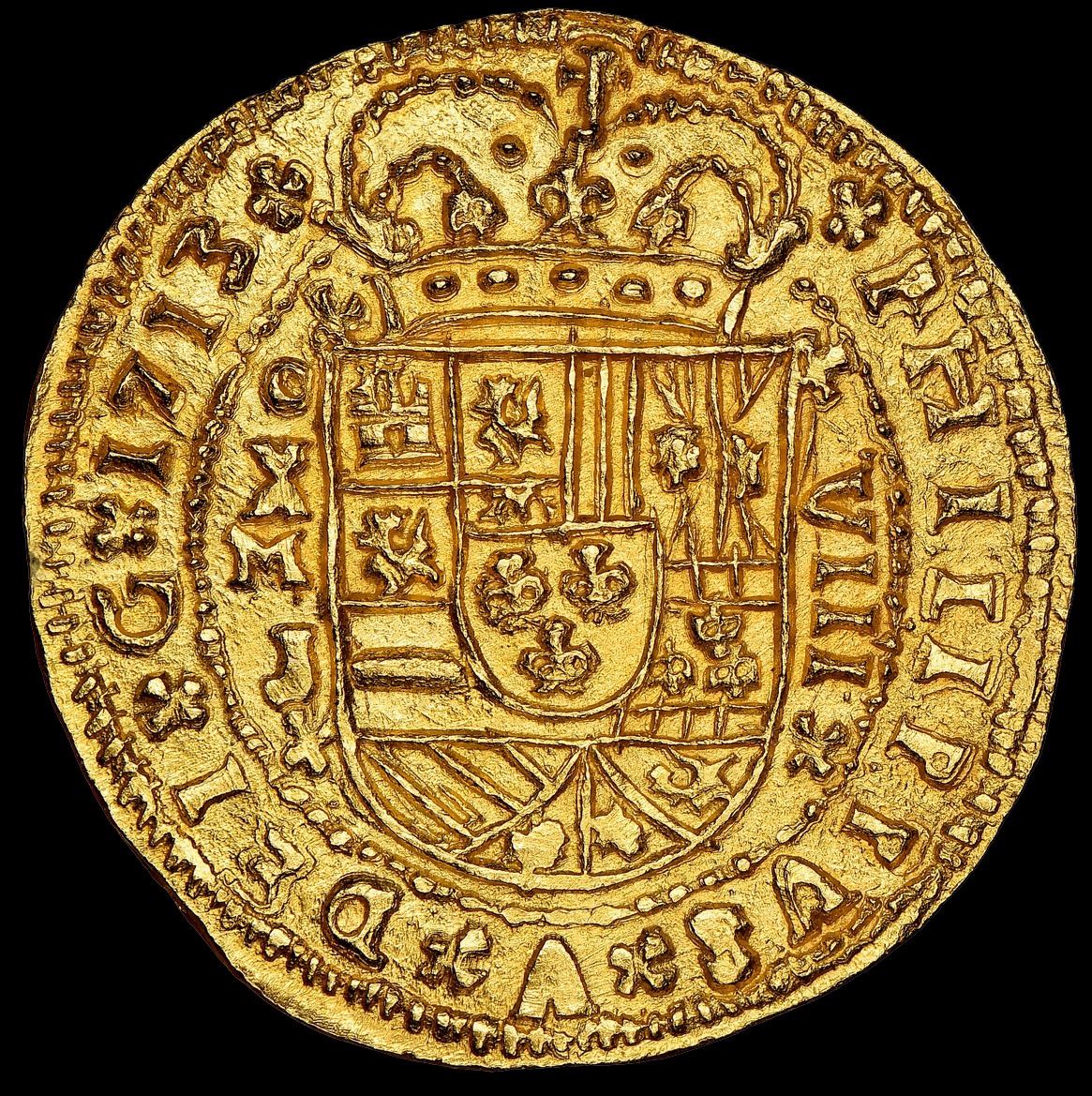
Mexico City, Mexico, cob 8 escudos Royal (galano), 1713J, extremely rare, NGC MS 66, finest and only example graded by NGC, ex-1715 Fleet (designated on special label). S-M30; Cal-2194; KM-R57.1. 27.03 grams. From the 1715 Fleet (Corrigan’s site), pictured on the cover of the November-December 1998 issue of Treasure Quest (a copy of which is included), with Fisher photo-certificate #42933, ex-Rudman. NGC #5909759-001.

Without question, the pinnacle of Spanish colonial coinage is the Mexican 8 escudos Royal (galano), a coin so large and beautiful and perfect as to be considered among the most desirable gold coins in the world. These 8 escudos Royals are quite rare, currently represented by just over 40 specimens across about a dozen dates within the 53-year span in which Mexico made gold cobs (1680-1732). There is no mistaking these special coins; while some regular cob issues come close (normally they are chunky and misshapen) and even some regular-planchet issues were struck with Royal dies (arguably trial or test strikes), only true Royals are perfectly round and evenly struck on planchets of uniform thickness, not to mention that they were generally struck with obverse and reverse in medallic alignment (the present specimen actually rotated 90 degrees, but still oriented with cross aligned). These are formal presentation pieces, to be sure, but the exact purpose of Royals remains unknown, the details behind their commission apparently missing in archival records beyond simple line-item figures labeled “galanos.” While some dates of 8 escudos Royals today are represented by multiple specimens (the most abundant being 1702, 1711 and 1714) others are extremely rare or even unique. The date 1713 is in fact among the rarest, with only two known, the specimen offered here being the finer of the two and the only one graded by NGC. In terms of condition and quality of strike, we feel it is also among the finest of all the known dates.

Like the majority of known 8 escudos Royals, this coin was recovered from the wreckage of the Spanish Plate Fleet of 1715, eleven ships sunk on the reefs off the east coast of Florida in a hurricane in July 1715. It was actually two fleets, the combined Tierra Firme Fleet coming from Cartagena loaded with Peruvian and Colombian treasures, and the New Spain Fleet coming from Mexico with freshly minted coins and Asian jewels from the Manila Galleon trade, united in Havana for the northeasterly trip back to Spain. What had been an annual system of shipping to and from the New World was delayed for many years by the War of Spanish Succession after Charles II’s death in 1700, causing the treasure to pile up in Mexico and Colombia. Spain desperately needed this wealth back home and could not wait for the Fleet to delay any longer when it finally left Havana in July, evidently right into the path of a hurricane. There were many survivors, who encamped on the shores opposite the wrecks, and Spain was able to organize some salvage, only to experience their other nemesis when pirates absconded with much of the recovered treasure. It is impossible to say how much of the 1715 Fleet treasure was saved in its time, or even how much was on board (as contraband could account for perhaps double the amount on the manifest); suffice to say the currently eight known wrecksites (some of which may be parts of the same ship) from present-day Melbourne down to Stuart (aptly called the “Treasure Coast”) have kept divers and beachcombers busy since at least the early 1960s, when Kip Wagner and the Real Eight Co. began organized salvage and instituted a State lease system that is still in place today. The first Royals, in fact, were found by Real Eight and offered at auction as early as 1964.

The coin we are offering here was recovered in August 1998, the find of a lifetime for diver Clyde Kuntz of the salvage vessel Bookmaker (captained by Greg Bounds), under a lease held by the Mel Fisher company , whose photo-certificate (“GRADE: One ++”) accompanies the coin. According to the November-December 1998 issue of Treasure Quest magazine, the cover of which features a photo of this coin, Clyde was working the “Corrigan’s” site , about five miles north of Vero Beach, when on the same day he found both this coin and another 8 escudos Royal dated 1698 (currently unique) that is now permanently housed in the State of Florida collection. The biggest single find of Royals came in the 2015 diving season, in which a staggering ten pieces (dated 1711, 1712 and 1715) were recovered under leases held by Queens Jewels, LLC (the current owner of the 1715-Fleet site leases). Subsequently, we appraised those coins for millions of dollars for Queens Jewels and the State of Florida, which gets a 20% cut of all finds.

The only other known 1713 example , reportedly found on the beach in the 1980s, made headlines in 1985 when it was sold at the January F.U.N. auction (Kurt Krueger) in Florida. The same coin sold in Switzerland in 1991 as part of the Emilio Ortiz collection. According to census information, that coin has not been graded, but we note that it was struck on a smaller flan (also slightly lower weight, at 26.84 grams) with slightly fewer peripheral details than the piece we offer here.

While any one of the Royals is a joy to behold, with full and well-struck details on big, round flans, in our 2015 appraisal we noted that there is actually a good bit of difference in quality (strike and condition) between all the known specimens, even within the same date, in addition to the differences in rarity. Anyone who has ever attempted striking a coin by hand knows that making coins like these requires great strength and dexterity. Hitting on dead center with full pressure on the entire canvas—without bouncing the hammer—is easier said than done. It is no exaggeration to say that a well-struck handmade coin demonstrates a level of skill far greater than what is required to make a beautiful milled coin. In fact, at least one researcher asserts instead that Mexican Royals must have been struck with a screw-press instead, using multiple pressings to achieve such completeness of detail. Also consider the dies: Each Royal die was specially prepared with as much care and aesthetics as the mint could muster, using the same punches available for regular issues but with greater attention paid to concatenation and placement, usually allowing for more ornamentation in the legends and around the inner details. The 1713 issue, for example, has strange X-shaped flowers that appear both as stops in the legend and as space-fillers in the four “corners” of the shield (an aspect of this date only). Presumably important and wealthy people (some would say the King himself) were depending on the mint to make these jewels as near to perfect as possible.

The twelve or thirteen known dates come in five basic types, most easily recognized by their styles of crosses:
Plain Cross: 1695 , 1698
Box-End Cross: 1702
Crosslet Cross: 1711, 1712, 1713
New Cross: 1714
New Cross with Bouquets: 1715, 1717, 1718 (if it exists), 1723, 1728/5, 1729
It should be noted that regular-issue 8 escudos also use these styles, in addition to two more types (used concurrently with others) that at present are NOT represented by any Royals:
Jeweled Cross: 1680-1699
Ornate-Tressure Cross: 1711-1712

While each date within the Crosslet-Cross type of Royals dated 1711-1713 is slightly different in execution, the basic design did not change and in fact marks the end of a rustic style replaced in 1714 with a vastly sharper and more polished design, which some believe can be traced to the implementation of press-type machinery. These post-1713 issues are also generally on smaller, thicker flans.

The 1713 we offer here—arguably finer than any of the known 1711’s and 1712’s and easily superior to the other known 1713—therefore represents the final perfection of the rustic style of the Crosslet-Cross type. Of course the complete lack of wear is a factor, but there is more to it than that: This coin is just SO WELL STRUCK that it glistens from every angle, its color changing from yellow to gold as it turns in the light, the exceptionally deep and skillful strike making sharp peaks out of every design element, with near-perfect centering (especially the obverse) and no doubling or weakness anywhere, all on a huge and essentially flawless flan that extends beyond the outer border of dots. This is best appreciated in hand, or at least in video, where movement reveals the flash of luster that so distinguishes this coin. Just as it has been up till now (in the Isaac Rudman numismatic cabinet), such a perfect specimen will be at home in any of the best coin collections currently being formed around the world, whether focused on colonials, U.S., world or even shipwreck. Mexican 8 escudos as a type are so rare that we have never offered one in our auctions before, and we are honored that our first is indeed one of the most beautiful coins we have ever offered. It will be hard to match this rarity and perfection for a long time.

Updated Census of Known Mexican 8 Escudos Royals by Date
Date King Assayer Quantity known
1695 Charles II L 1
1698 Charles II L 1
1702 Philip V J 7
1711 Philip V J 8
1712 Philip V J 4
1713 Philip V J 2
1714 Philip V J 9
1715 Philip V J 5
1717 Philip V J 1
1718 Philip V J 0
1723 Philip V J 1
1728/5 Phi.V/Louis I D 1
1729 Philip V R 1

_________________________
FOOTNOTES:

– As the table at the end of this article shows, only twelve dates are confirmed, with one more mentioned in references.

– Mel Fisher had worked with Real Eight from 1963 to 1972 and then moved to Key West to pursue salvage on the 1622 Fleet (Atocha and Santa Margarita). Real Eight maintained the 1715-Fleet leases until abandoning them in 1977. Mel Fisher resumed salvage on the 1715 Fleet in 1979. In 2010, Mel Fisher’s family sold the leases to Queens Jewels LLC, which manages salvage there today.

– The wrecksites of the 1715 Fleet are referred to by nicknames as opposed to the actual names of the ships themselves, because in most cases it is uncertain where each of the ships sank. “Corrigan’s” is named after 1950s beachcomber Hugh Corrigan, whose house fronted that stretch of beach.

– Amazingly, this other 1713 was struck from different dies from the present coin. In fact, most if not all of the non-unique dates exhibit multiple dies. Our theory is that the amount of striking pressure required to properly make these big coins with full and bold details caused the dies to break after only a few strikes, and probably there were lots of failed attempts that were just re-melted. While it seems like a waste of resources to make fresh dies to net just a few coins (or less!), consider that these were special issues commissioned by or for wealthy dignitaries who could afford the extra expense and didn’t need lots of coins.

– The single-known specimen of the date 1695, originally sold in the Ubilla-Echevez auction by Christensen in 1967, set a record in 2009 for the most ever paid for a Spanish American gold coin at close to $600,000.
The “bouquets” are floral-bouquet ornaments in the dimples of the tressures and appear only on Royals. They are not the same as the “daggers” in the same positions on the New Cross issues of 1714 and 1715.

– Researcher Philip Flemming points out that the Plain Cross was “aesthetically a better choice” for Royals than the Jeweled Cross, but why the Ornate-Tressure Cross was not used on Royals is a mystery (December 2016 issue of the U.S. Mexican Numismatic Association’s Journal).

– This table is adapted from Kent Ponterio’s preface to Ponterio and Associates’ Auction #108 on April 7-8, 2000. Kent listed only publicly known examples, with detailed information of their appearances. Our only updates to Kent’s work are the addition of ten 8 escudos Royals found in 2015 (seven 1711s, two 1712s and one 1715) and a correction to the 1728 (now recognized as 1728/5 and PHILIPPVS/LVDOVICVS).

– Spanish references by Calicó (Numismática española [2020] and La Onza [2004]) and Tauler (Oro Macuquino [2011]) do list the date 1718, but without photos or any other information. The whereabouts of any specimen(s) is unknown to us, so for now we treat it as quantity 0.
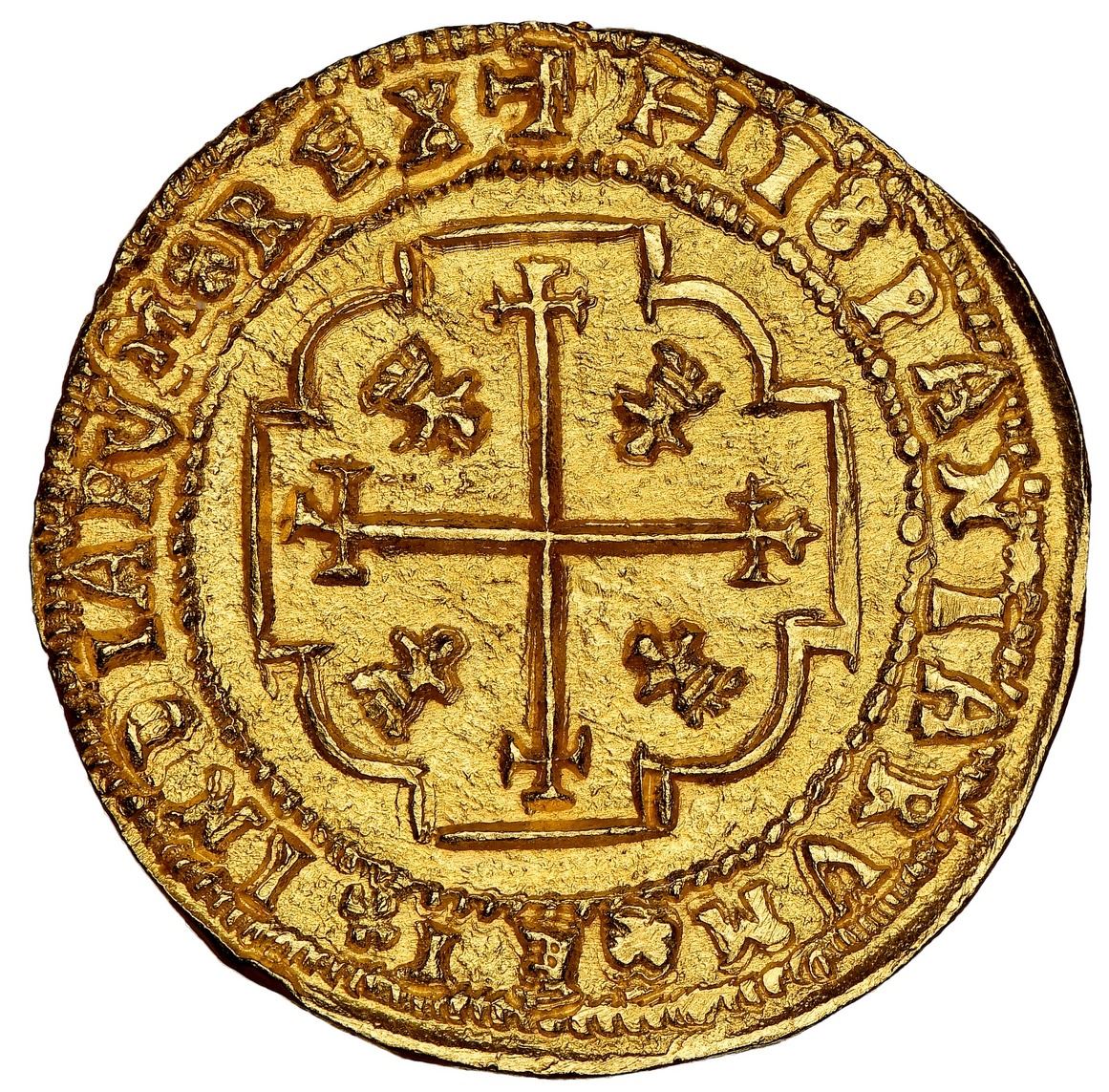
https://www.numisbids.com/n.php?p=lot&sid=4266&lot=487

Lote 487. Nueva clasificación / asignada erróneamente con anterioridad

https://auction.sedwickcoins.com/Mexico-City-Mexico-cob-8-reales-Royal-galano-1615-4F-very-rare-three-known-NGC-AU-details_i38817259
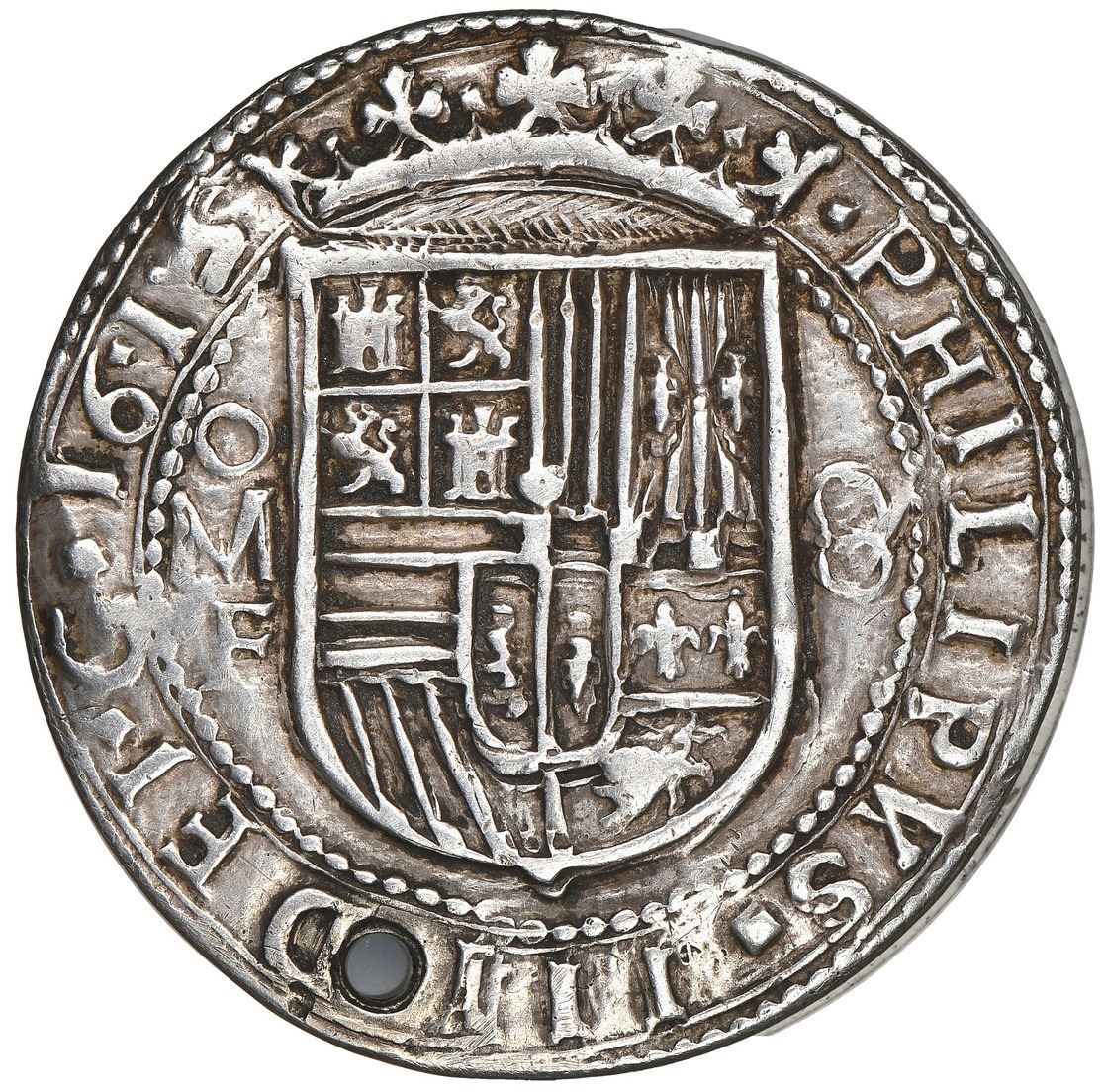
https://www.numisbids.com/n.php?p=lot&sid=4266&lot=490
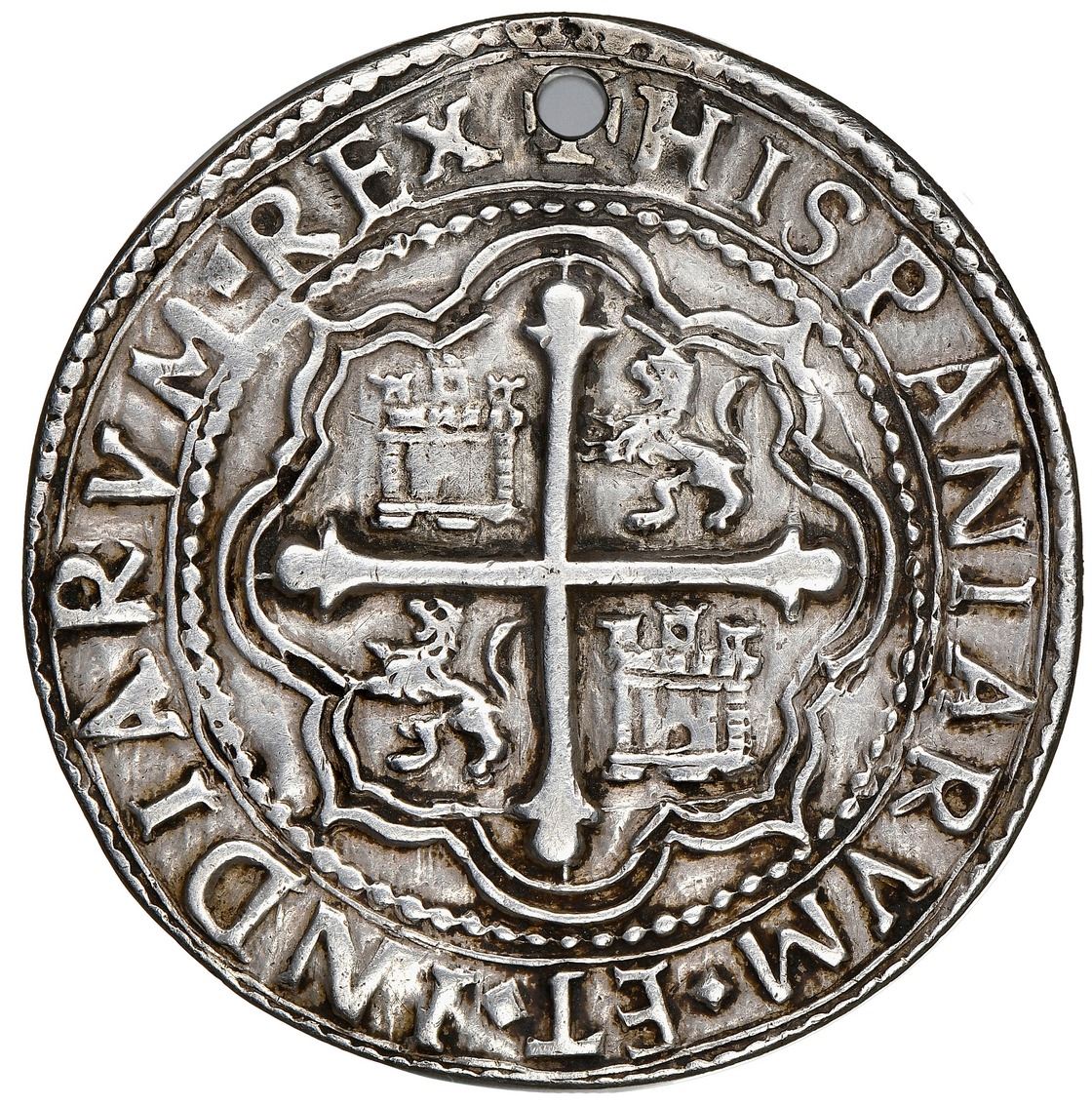
Lote 490. Raro galano

Y muchas moneditas más, además de objetos de naufragio, joyas…Curiosa subasta. ¡Os invito a dar una vuelta y disfrutarla! Habrá que estar atentos a los precios de adjudicación.

Más asequible – menos exclusiva, además de muchas otras diferencias y/o características, es la subasta de noviembre en sala de Konros
https://auction.conros.ru/olive/816/flash/

Pocos oros a la venta; hay demanda – poca disponibilidad. Bastantes rublos y medios de plata, además de denominaciones menores
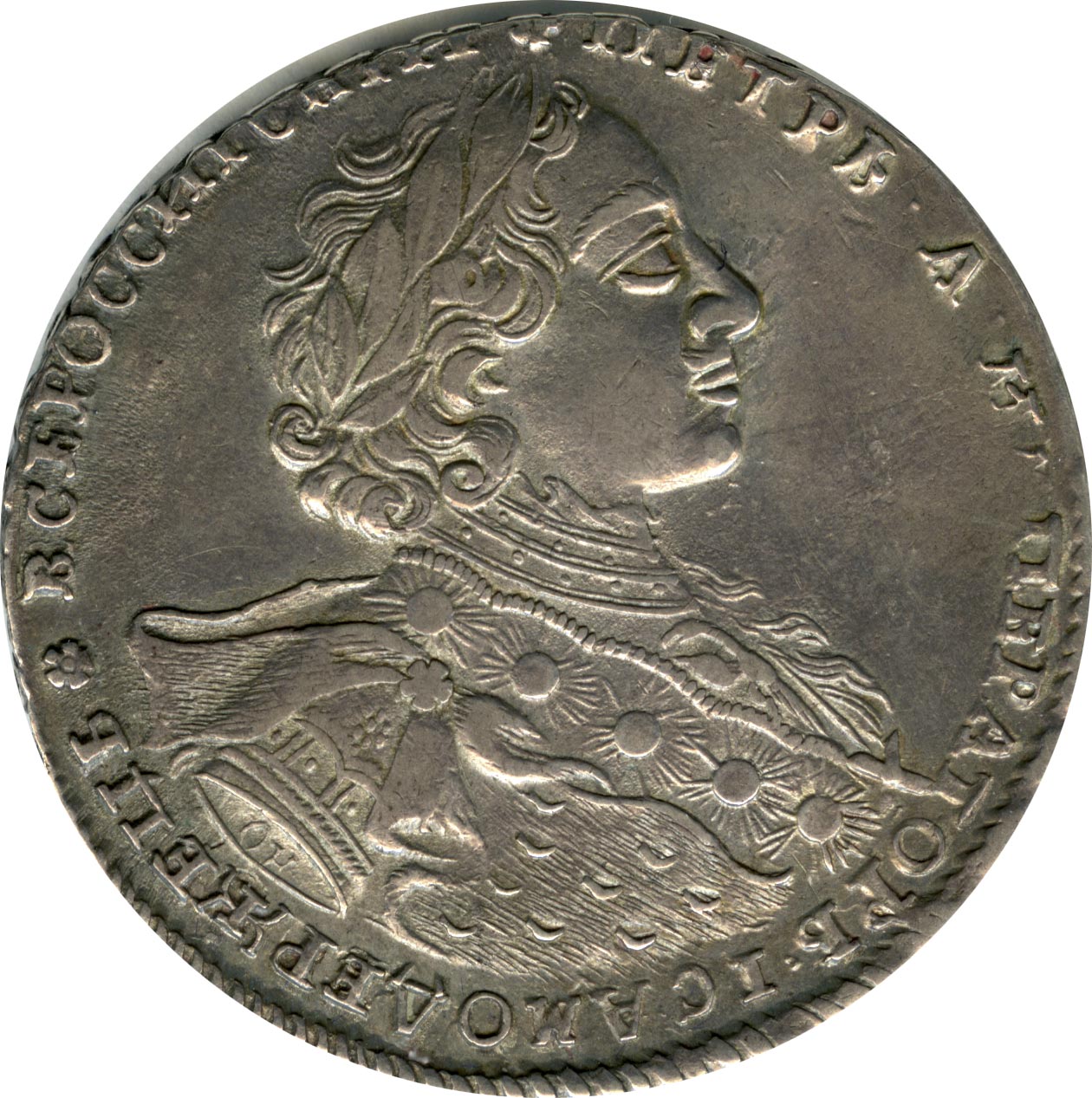
https://auction.conros.ru/lot/2669306/816/0/

Adjudicado en 155.000 rublos + comisión (+- 1.900 €)
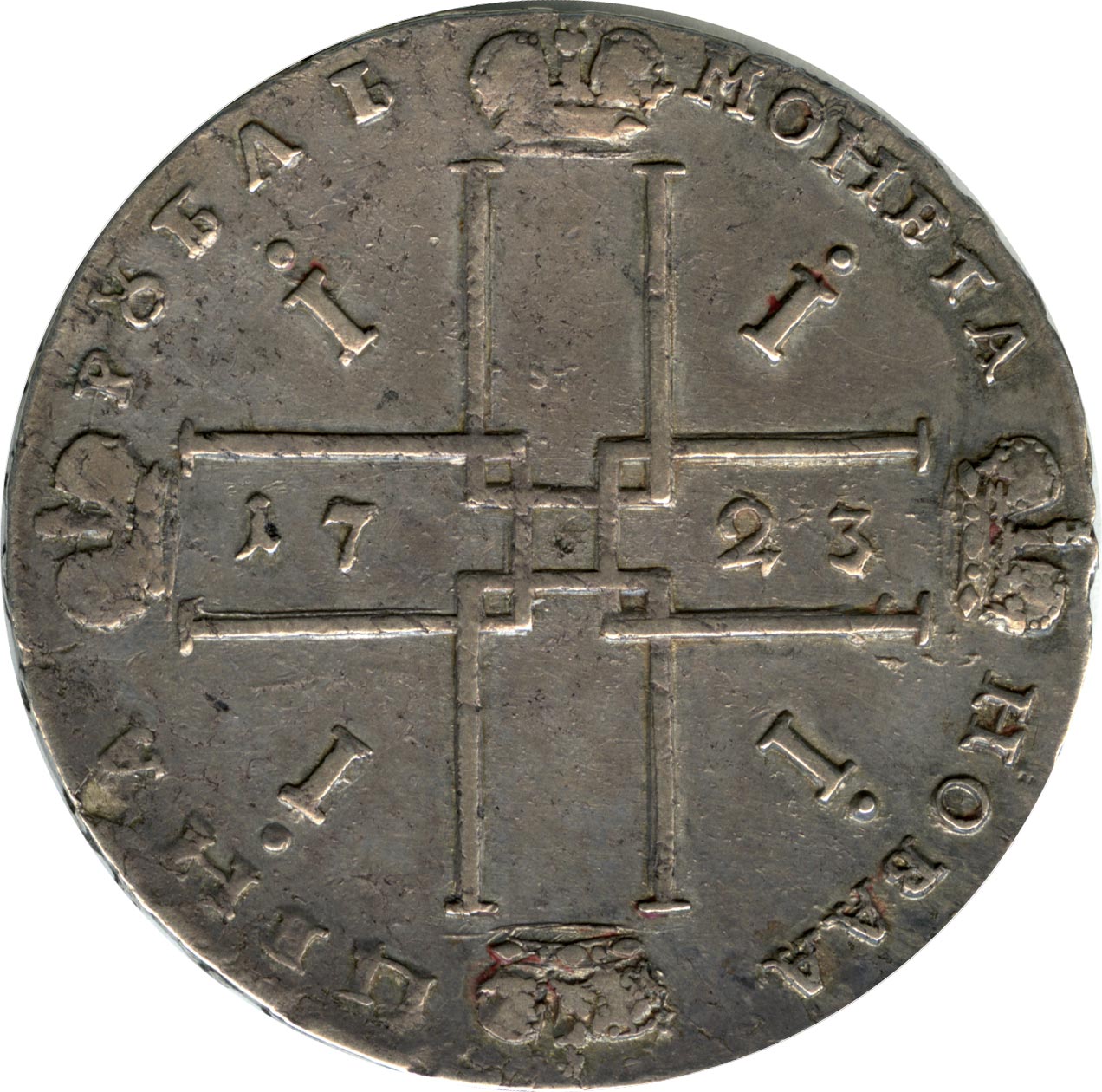
Рубль 1723 года «В горностаевой мантии»

В 1723 году портрет на рублевых монетах меняется, причем дважды. Первый вариант — у нумизматов он получил прозвище «тигровик» – примечателен тем, что на нем латы царя прикрыты горностаевой мантией, а на груди — знаки ордена Св. Андрея Первозванного. В обрезе рукава вновь появляется знак ОК. Выделяют четыре типа лицевой стороны по наличию и размеру андреевского креста на груди.

Разновидности оборотной стороны различаются расположением букв легенды против i.

Гуртовая надпись – «Российский рубль Московского двора», по всей видимости, такое обозначение продукции московского Кадашевского двора связано с ожидаемым началом работы нового монетного двора в Санкт-Петербурге.

Легенда лицевой стороны – «Петр А (Алексеевич) Император и Самодержец Всероссийский», оборотной – «Монета новая цена рубль» и дата арабскими цифрами. Проба — 729, вес 28, 44 грамма.

96 копеек 1757
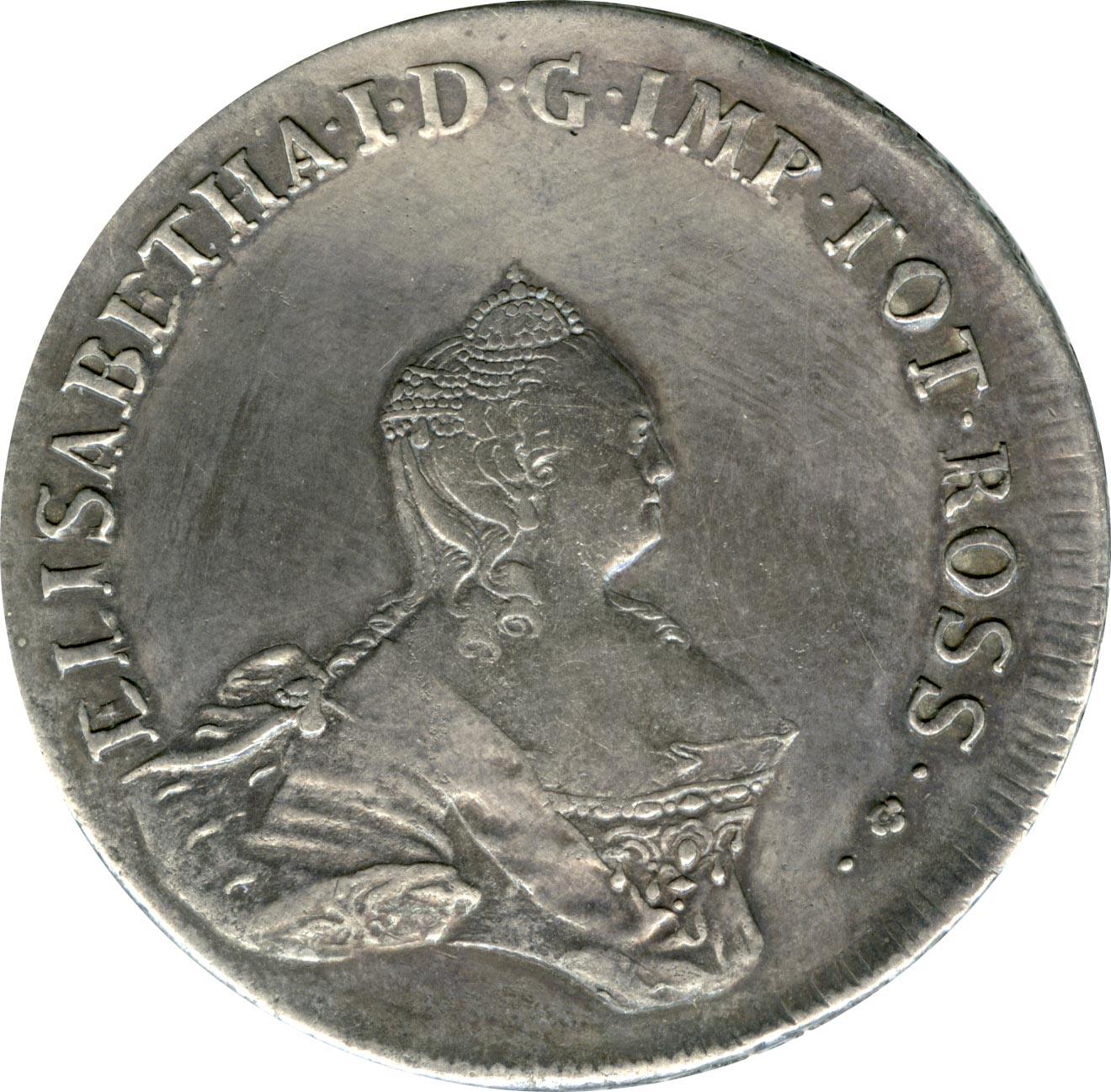
https://auction.conros.ru/lot/2669315/816/0/

Adjudicado en 160.000 rublos + comisión (+- 1.950 €)
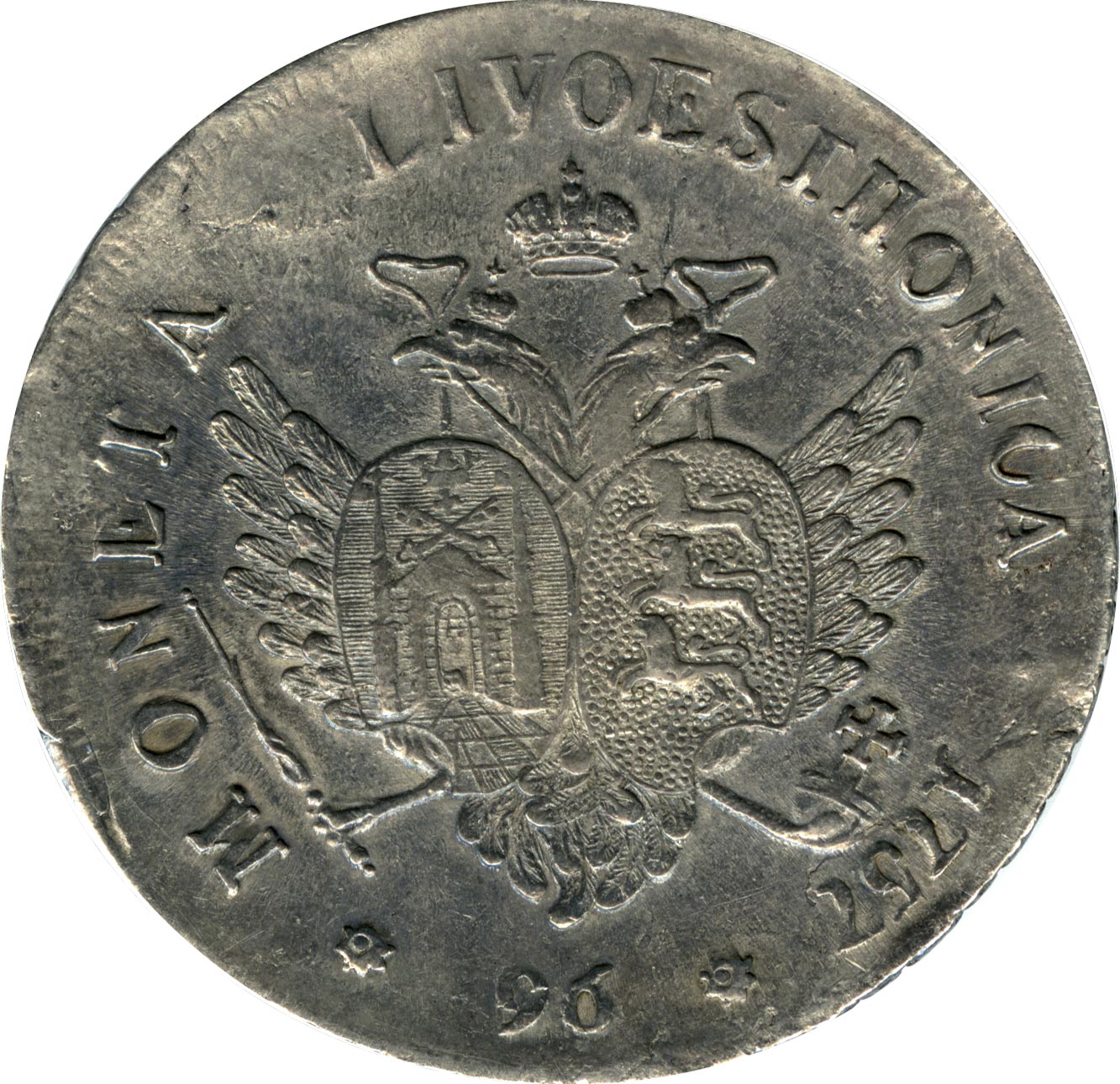
96 копеек «Ливонез»

Следующий номинал является очень непривычным для российской системы денежного обращения, поскольку ориентирован не на десятеричную, талерную. Внешнеполитические успехи елизаветинского времени оставили свой след в двух региональных выпусках монет. Первый — это монеты для прибалтийских провинций Ливонии и Эстляндии.

Необычный номинал свидетельствует о попытке привязать русскую денежную систему к талерной, основанной на 12-кратном счете и привычной для населения провинций. На оборотных сторонах монет 96, 48 и 24 копейки в клювах орла на лентах подвешены гербы городов Риги и Ревеля (с 1917 года — Таллин).

Чеканились в Москве на Красном дворе петербургскими штемпелями работы Б. Скотта.

Лицевая сторона — портрет императрицы, оборотная — российский двуглавый орел с гербами Риги и Ревеля и надпись MONETA LIVOESTHONICA, цифра 96 и дата. Проба — 750, нормативный вес — 26,38 грамма, гурт — узор.

Por aquí os dejo los enlaces de las dos (2) últimas subastas en sala anteriores, para que comparéis

https://auction.conros.ru/clive/809/flash/

https://auction.conros.ru/clive/805/flash/

P.S. En próxima subasta de Vico, curioso 8 escudos platino 1776 – Lima, falsa de época

https://www.numisbids.com/n.php?p=lot&sid=4291&lot=538
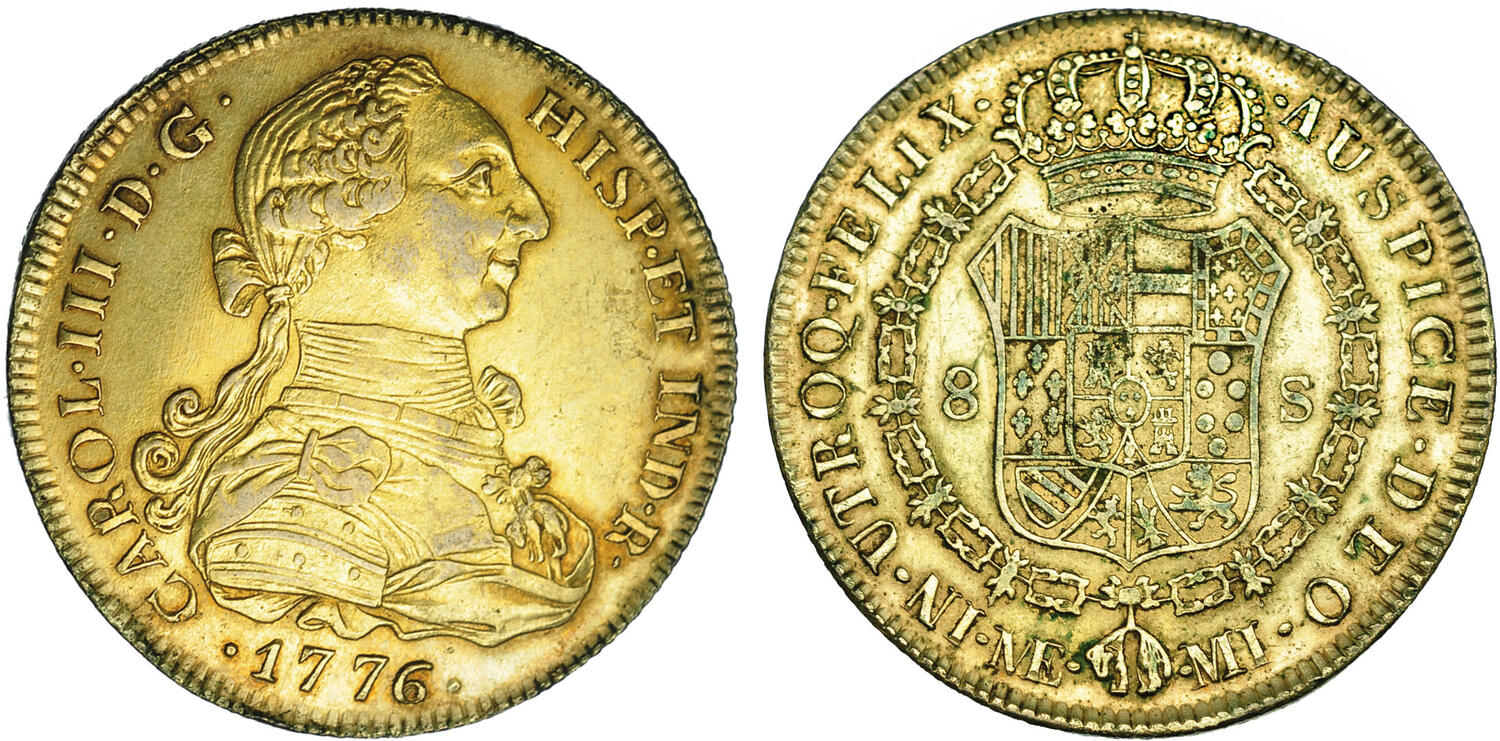
Lot 538         Starting Price: 600 EUR  Minimum bid: 600 EUR

8 escudos. 1776. Lima. MI. Falsa de época en platino dorado. 27,1 g. Barrera-358. MBC+.

Abriendo la imagen en pestaña aparte se aprecian mejor los detalles