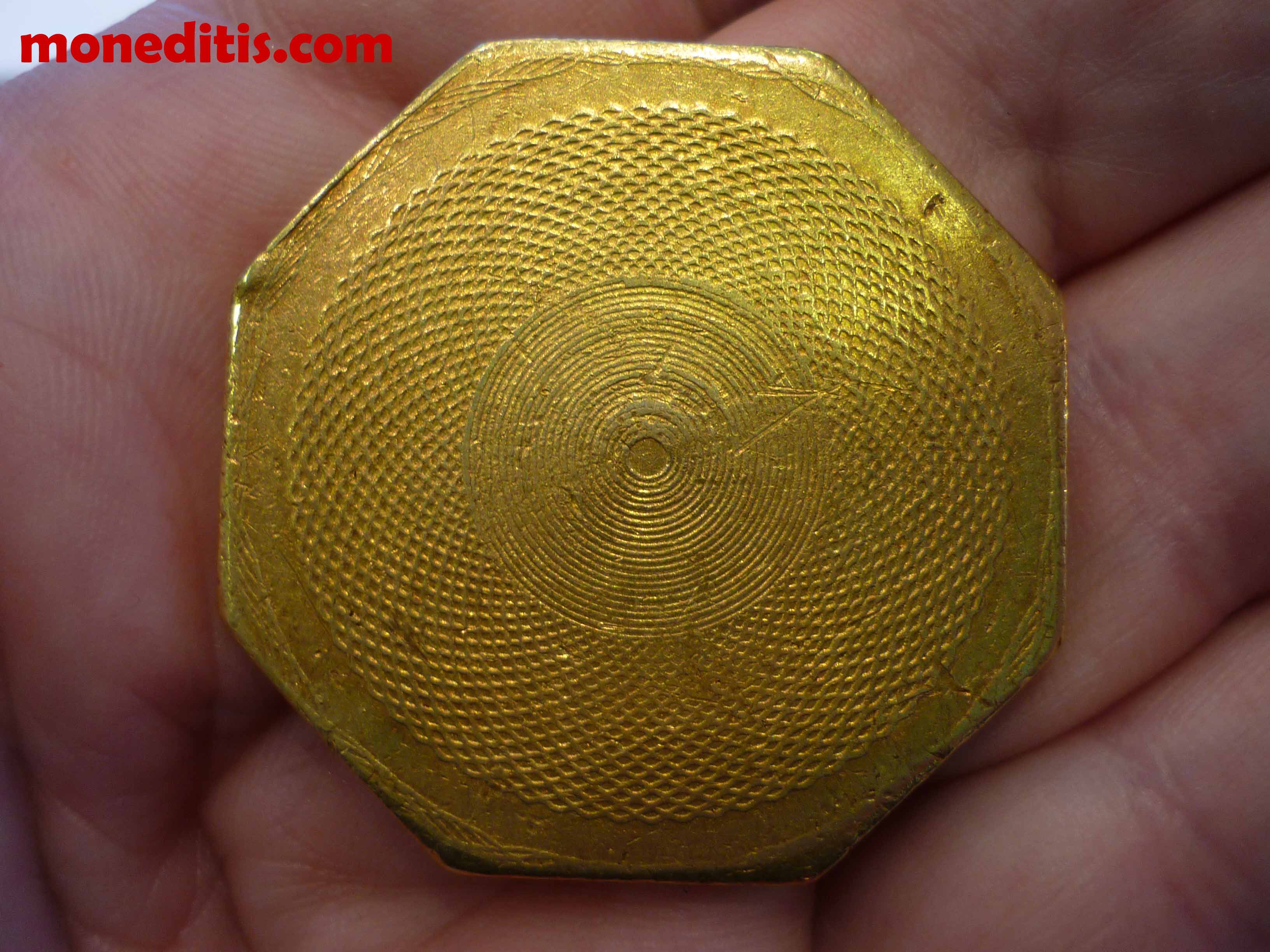
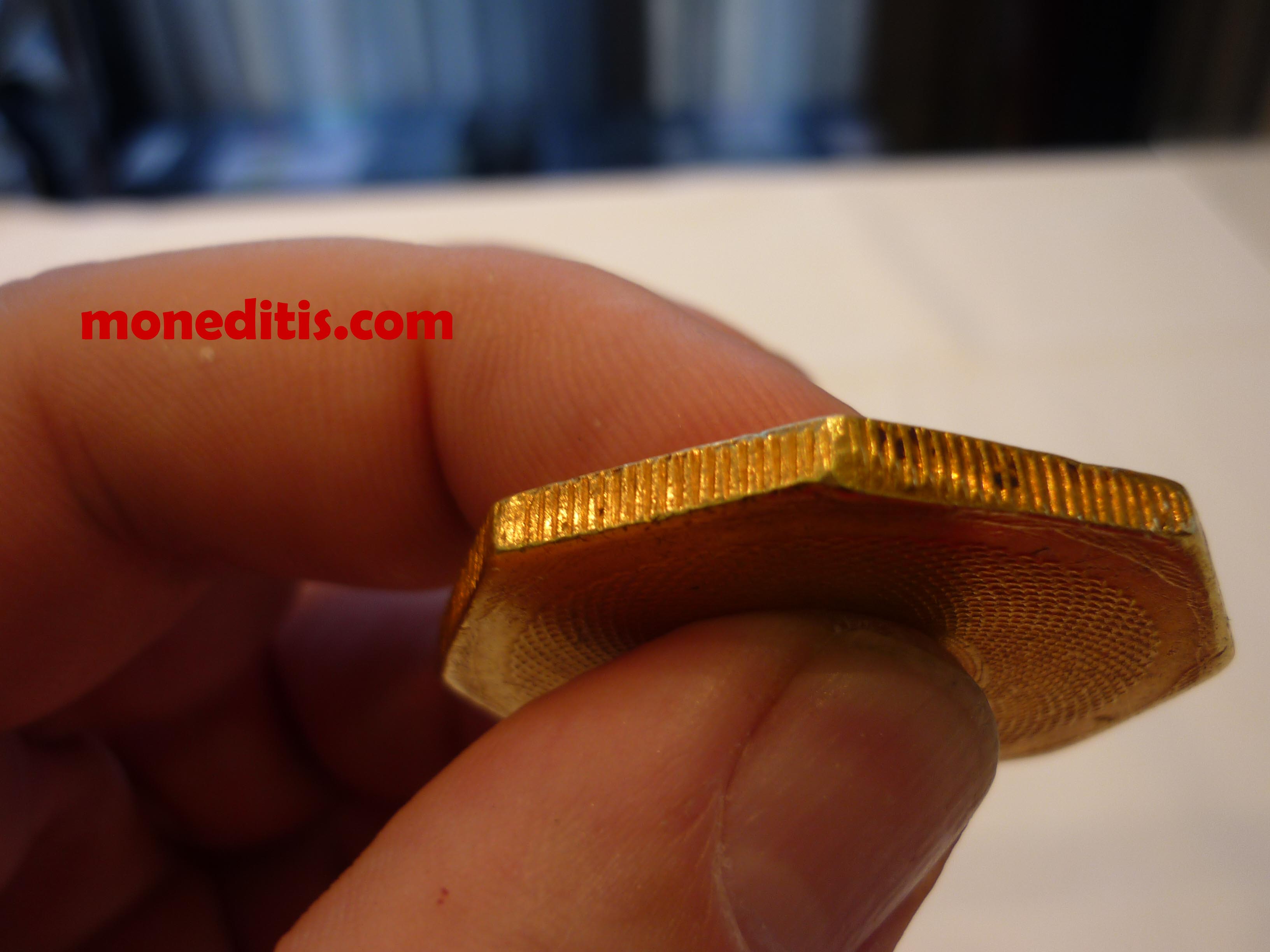
84,73 g. Au .887 Assayer: Augustus Humbert. San Francisco. Gold Rush


Nice and rare freemasonry? 50 $ coin
http://www.christies.com/lotfinder/lot/1851-augustus-humbert-us-1958429-details.aspx?intObjectID=1958429
http://www.christies.com/lotfinder/lot/1852-united-states-assay-1958435-details.aspx?pos=8&intObjectID=1958435&sid=&page=12&lid=1
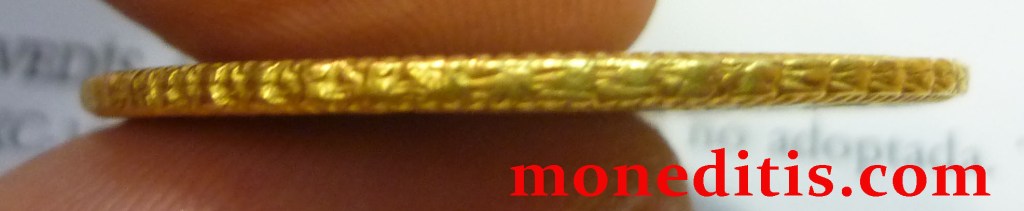
Die notes: Octagonal format. Obverse with central motif of eagle perched on a rock, holding a shield, and in its beak a long ribbon inscribed LIBERTY. Above, a label or cartouche on which the fineness was stamped. Surrounding: UNITED STATES OF AMERICA, and below, D and C, to be stamped for values in dollars and, if applicable, cents (none are known with a cents imprint). Reverse with engine-turned design. Edge lettered: AUGUSTUS HUMBERT UNITED STATES ASSAYER OF GOLD CALIFORNIA 1851. Die state: Perfect dies. PCGS Data: The single finest of three examples from the S.S. Central America treasure certified by PCGS.The Humbert $50 «Slugs» In California in 1849 and early 1850, monetary matters were in a state of flux. Many different private issues-coins and ingots-had appeared under the imprints of Kohler; Norris, Gregg & Norris; Bowie; the Miners Bank; Baldwin & Co.; Moffat; and others. Some of these had intrinsic or melt-down values close to their stated face values, while others did not. Seeking to add stability to circulating gold coins, in September 1850 Congress authorized the secretary of the Treasury to contract with a well-established assaying business in California to affix the stamp of the United States to bars and ingots, to assay gold, and assign value to it. Moffat & Co., the most respected of the San Francisco coiners, and probably the one with the best «connections,» received the commission. Appointed to the position of United States assayer was Augustus Humbert, a New York City maker of watch cases, who arrived in San Francisco on January 8, 1851. Meanwhile, in preparation for the new franchise, in late 1850, Moffat & Co. curtailed most of their private business and prepared to issue coins under the government contract. New premises were secured on Montgomery Street between Clay & Commercial streets. While Moffat was preparing for issuing coins under the federal franchise, it issued no coins under its own imprint. The gap was filled with alacrity and enthusiasm by Dubosq, Baldwin, and Schultz-earlier discussed in the present catalogue. Not long thereafter, Moffat vanquished its competitors via James King of Wm. and the resultant smear campaign-also related earlier.$50 Slugs MintedThe production of federal coins, determined to be of $50 denomination, promised great profits for Moffat & Co. in early 1851. On February 14, San Francisco Prices Current contained an article relating to the $50 slugs, indicating their regular production was about to begin: «The above cut represents the obverse of the United States ingot, or, rather, coin, of the value of $50, about to be issued at the Government Assay Office. It is precisely of this size and shape…. The reverse side bears an impression of rayed work without any inscription. Upon the edges following: ‘Augustus Humbert United States Assayer-California Gold 1851.’… The fifty-dollar pieces will be of uniform value, and will be manufactured in the same manner as coins…. By order of the secretary of the Treasury these ingots and coin are to be received for duties and other dues to the United States government, and our bankers, we are advised, will receive them at their stamped value. This will produce an important change in the monetary affairs here, gold dust will immediately go up, and as a necessary consequence foreign and domestic [Eastern] exchange will be at a premium 5 to 7…» The Alta California commented on the new $50 pieces on February 21, 1851: «The new 50-dollar gold piece…was issued by Moffat & Co. yesterday. About three hundred of these pieces have already been struck off…. The coin is peculiar, containing only one face, and the eagle in the center, around which are the words ‘UNITED STATES OF AMERICA.’ Just over the eagle is stamped «887 THOUS.» signifying the fineness of the gold. At the bottom is stamped ’50 DOLLS.’ The other face is ornamented with a kind of work technically called engine-turning, being a number of radii extending from the common centre, in which is stamped, in small figures, ’50.’ Around the edge is stamped the name of the United States Assayer….» At the time, some of the pieces were inscribed 880 THOUS., while a few others were noted as 887 THOUS. (per the above newspaper account). Later varieties of $50 issues had the denomination marked «FIFTY DOLLS» and as part of the die inscription. These seem to have replaced the very early issues (such as the S.S. Central America coin offered in this lot) which had the value and fineness individually hand punched. From the preceding, it seems reasonable to conclude that the coin here offered was part of the group released on February 20, 1851, and that later pieces were all of the «DOLLS» type. In the first quarter of 1851 the Moffat-Humbert coiners produced $530,000 worth of pieces. This is equal to 10,600 $50 pieces. It further seems reasonable to assume that only a few of the style with the «50» value, «880» or «887» fineness, and eight edge segments hand stamped were made, and that late February and all March pieces were of the type with the value and fineness in the die and with reeded edge.Steps in Minting an 1851 $50Lettered Edge Type The large and impressive lettered edge $50 coins made in February 1851 were created by a very complicated process involving the following separate steps once the planchet was produced, quite possibly the most complex set of minting steps for any coin ever authorized by the American government (or any other kind of coin of which we are aware). Step 1. The obverse and reverse motifs were stamped from a pair of dies. These dies had been made in New York City by Humbert and brought with him to California. The obverse features an eagle holding a shield, perched on a rock, with a thin ribbon inscribed LIBERTY in its beak. Above is a blank ribbon suitable for inscription. The dies of this style were the work of Charles Cushing Wright. One pattern impression in copper is signed on the edge by Wright as «Wright fec,» for «Wright fecit» (Latin for «Wright made it»). Inscriptions on these patterns as well as the first octagonal ingots produced for circulation have simply the letters D C DWT. GRS. It was intended that the value in dollars and cents and the weight in pennyweights and grains could simply be stamped in the place provided. In this way ingots of $50, $100, $200, or any other desired denomination could be produced, differing from each other only by size, weight, and fineness, but incorporating the same stamp. · The reverse is of a geometric «engine turned» design similar to that used on a watch case, and reflects Augustus Humbert’s skill as a maker of such cases-one of the occupations he had followed in New York City. Steps 2-4. The fineness was hand-stamped on the obverse with three separate numeral punches. Finenesses known to have been thus applied include 880 (as usually seen) and 887. Steps 5-6. The value (50) was hand-stamped on the obverse, from two single punches. Steps 7-14. In eight separate operations each of the eight edge faces was stamped with a logotype punch, the eight punches reading incuse: AUGUSTUS HUMBERT UNITED STATES ASSAYER OF GOLD CALIFORNIA 1851. There was no particular starting or stopping place for the inscriptions, and the position of a given part of the inscription varies with relation to its position to design elements. The several specimens of this variety examined by the writer (QDB) in recent months as part of a numismatic study have each had the lettering inverted in relation to the obverse (this being true of the presently offered S.S. Central America example as well). Thus, it took at least 14 steps to create one of the early $50 pieces. Later coins with the fineness and value in the die and with reeded edge were struck in a single operation. Some had the denomination 50 stamped at the center of the reverse, an additional procedure.Additional Notes While the federal standard for gold coinage was 900 1000 fine, in San Francisco in 1851 this was difficult to attain with the refining processes then in use, and the Humbert coinage was of two finenesses, 800 and 887, the latter coins being slightly lighter in overall weight due to the smaller proportion of alloy. By 1852, coins of 900 fineness were being made, but other finenesses (884 and 887) were employed as well. The remaining alloy was native silver (whereas under the government standard, copper was used). Although the Humbert $50 pieces were clearly produced under government auspices, and although they were receivable for U.S. customs payments in San Francisco, in Philadelphia on April 23, 1851, Mint Director George N. Eckert perversely (it would seem) stated that while Augustus Humbert was the United States Assayer in California, his stamping of bars for owners of bullion did not make them legal tender.$50 Gold: Massett Writes Steven C. Massett, accomplished entertainer and co-owner and co-editor of the Marysville Herald, was in San Francisco on May 3, 1851 to give a concert. He later recalled what happened, this being the time of the great fire: «At the time T. Butler King, Esq., was collector of the port, and running for U.S. senator. Our paper supported his election, and the consequence was that a very ‘fat’ advertisement fell to the lot of the proprietors of the Marysville Herald, to the tune of $1,800, which amount was duly handed to me in octagonal fifty-dollar gold pieces, and which was lodged for safekeeping at the banking house of Burgoyne & Co., at the corner of Montgomery and Washington streets. «The deposit was made the day after my concert had taken place. Consequently I have about $2,500 ‘on call’ there at the time. «I was standing at the top of Clay Street, near Pike, when the fire was raging at its height. Block after block of buildings were caught in the fiery embrace. Union Hotel, [Jenny Lind] Theatre, El Dorado building-all were swept away, and at last the flames caught the Bank of Burgoyne & Co., whose building was considered fireproof. It was seemingly enclosed in sheets of flame, and many a heart quailed in expectation of losing every cent there deposited, for the heaviest accounts in the city were kept at this pet banking establishment. If my friend J.R.C. ever reads these lines, he will recollect the query I put to him, as to whether he though the place would stand! «On that night everybody slept in the open air, on the top of barrels, bales, or anything else-there did not seem to be the vestige of a house left. Utter desolation and despair reigned supreme. «About 10 o’clock on the following morning, George Plume, one of the firm, upon going to the safe (one of the celebrated Herring’s by the way) handed me my buckskin bag of gold, with even the sealing wax not melted! «So much for a good safe, and my luck!»










 moneditis real deaocho